'Gut punch': Why Wall Street is raising recession odds amid the Iran war
A potential jump in prices could ripple through the economy, some experts said.
The U.S.-Israeli attacks on Iran set off one of the worst global oil shocks in decades, prompting gloomy forecasts in recent days about the heightened risk of a U.S. recession.
Goldman Sachs raised its probability of a recession in the next 12 months from 25% to 30%, while Moody’s Analytics pegged U.S. recession odds at just below 50%. EY Parthenon put the risk of a recession over the next year at 40%, but it warned that those odds “could rapidly rise” if the Middle East conflict worsens.
A prolonged oil shortage could drive up prices for a vast array of goods, sapping energy from consumer spending, which powers most of the nation’s economic growth, some economists told ABC News. Inflation may also push the Federal Reserve to raise interest rates, they added, tipping the U.S. closer to a downturn.
Still, experts cautioned that the outcome remains highly uncertain, since questions abound regarding the severity and duration of the Iran war.
Mark Blyth, a professor of political economy at Brown University, called the war a “real gut punch” for the U.S. economy.
“If things become too expensive, people stop buying them and that hurts growth,” he added.
The link between the Iran war and the U.S. economy stems from oil and gasoline prices, which in turn threaten steep increases in prices paid by shoppers and costs borne by businesses, some economists said.
Iran has mounted a near-closure of the Strait of Hormuz, a critical maritime trading route along the coast of Iran that facilitates the transport of about one-fifth of the global oil supply.
The U.S. is a net exporter of petroleum, meaning the country produces more oil than it consumes. But since oil prices are set on a global market, U.S. prices move in response to swings in worldwide supply and demand.
The disruption in oil shipping has pushed global crude prices above $112 a barrel, which marks a staggering rise of nearly 60% since the war began on Feb. 28.
The average price of a gallon of gasoline stands at $3.99, jumping $1.01 over the past month, according to AAA data.
“Gasoline is a necessity – you have to get to work and pick the kids up from school. If the price of one thing goes up, people will cut back somewhere else. That can have ripple effects,” Claudia Sahm, chief economist at New Century Advisors and a former Fed official, told ABC News.

The U.S. economy experienced 11 recessions between World War II and the onset of the COVID-19 pandemic, Deutsche Bank said in a note to clients this month, which also noted that six of the downturns were preceded by, or closely coincided with, a year-over-year rise in oil prices of at least 50%.
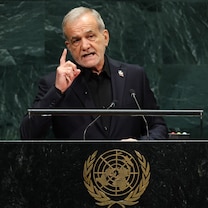


In an effort to lower oil prices, the Trump administration has announced a release from the strategic oil reserve, eased sanctions on Russian oil and suspended a key regulation of domestic oil transport. The president has also sought to restore tanker traffic in the Strait of Hormuz.
In a post on social media on Monday, Trump said the U.S. is in "serious discussions with A NEW, AND MORE REASONABLE, REGIME to end our Military Operations in Iran." Trump did not identify with whom the administration is negotiating.
A potential jump in costs for additional goods delivered through the Strait of Hormuz – such as fertilizer and diesel fuel – could also raise prices beyond gasoline, putting pressure on the Fed to hike interest rates in an effort to quell possible inflation, Blythe said.
The benchmark interest rate stands at a level between 3.5% and 3.75%. That figure marks a significant drop from a recent peak attained in 2023, but borrowing costs remain well above a 0% rate established at the outset of the COVID-19 pandemic.
If the Fed moved to raise interest rates, it would hike borrowing costs for many consumer and business loans, increasing the risk of a possible economic downturn.
“The Fed might have to raise rates and that will act as a brake on the economy,” Stewart Glickman, an analyst at research firm CFRA, told ABC News.
Speaking at Harvard University Monday, Federal Reserve Chairman Jerome Powell said that despite rising energy prices and the potential impact on inflation, he doesn’t think the central bank needs to raise interest rates.
“We feel like our policy is in a good place for us to wait and see how that turns out,” Powell said.
To be sure, economic forecasts are often inaccurate. Many Wall Street firms and economic analysts ratcheted up their recession odds in the aftermath of the Russian invasion of Ukraine in 2022 and the “Liberation Day” tariffs in 2025. In both cases, the U.S. economy averted a downturn.
“We should take some comfort that the U.S. economy has been very resilient. It’s a $30 trillion economy. It takes a lot to throw us in reverse,” Sahm said.
“The odds of a recession are elevated now, but it’s too early to be on recession watch,” Sahm added.
For now, uncertainty abounds, economists said. Precise recession odds likely depend on the duration and intensity of the fighting. A long war could push oil prices to stratospheric levels and hammer household budgets, economists said, while a speedy resolution could allow the economy to sustain continued growth.
“Right now, it’s impossible to say what comes next,” Sahm said.

Popular Reads
ABC News Live