President Donald Trump announced "major combat operations" against Iran on Feb. 28, with massive joint U.S.-Israeli strikes targeting military and government sites.
Trump set a deadline for Iran to fully reopen the Strait of Hormuz or face broad strikes on its critical infrastructure. Hours before the deadline expired, Trump said he had agreed to suspend planned bombing for two weeks if Iran agreed to reopen the Strait of Hormuz.
Iranian Foreign Minister Abbas Araghchi then said that "safe passage through the Strait of Hormuz will be possible via coordination with Iran's Armed Forces and with due consideration of technical limitations."
Israeli Prime Minister Benjamin Netanyahu said he supported the ceasefire with Iran, but that Lebanon -- where intense Israeli strikes continued -- was not covered by the agreement, despite Iranian protests.
2,055 killed in Lebanon since March 2, health ministry says
Israeli forces have killed at least 2,055 people and wounded another 6,588 in Lebanon since March 2, according to the latest tally from the Lebanese Ministry of Public Health.
Over the past 24 hours, 35 people were killed and 152 others were injured, the health ministry said Sunday.
Among those killed since March 2 were 165 children and 87 health care workers, the health ministry said. Meanwhile, another 644 children and 190 health care workers were among the injured, according to the health ministry.
-ABC News' Morgan Winsor and Ghazi Balkiz
Apr 12, 2026, 10:45 AM EDT
Despite blockade announcement, Trump urges Iran to open Strait of Hormuz
Despite his announcement Sunday of a U.S. naval blockade of the Strait of Hormuz, President Donald Trump also urged Iran to open the critical maritime waterway in a subsequent post on his social media platform.
“As they promised, they better begin the process of getting this INTERNATIONAL WATERWAY OPEN AND FAST!” Trump wrote, immediately after the post announcing the blockade.
The president claimed that “Iran promised to open the Strait of Hormuz, and they knowingly failed to do so,” adding that this has caused “anxiety, dislocation, and pain” to the world.
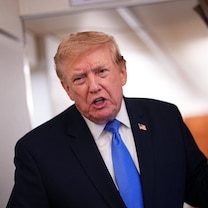
President Donald Trump speaks to the media, before boarding Air Force One on his way to Virginia, at Joint Base Andrews in Maryland, April 10, 2026.
Jim Watson/AFP via Getty Images
Trump proceeded to rail against the leaders of Iran, despite his previous insistence that there was regime change there and that the new leaders were more “reasonable.”
“There is great dishonor and permanent harm to the reputation of Iran, and what’s left of their 'Leaders,' but we are beyond all of that,” Trump wrote, adding that they were “very unyielding" during negotiations.
Trump did not go into detail about the negotiations but repeated what Vice President JD Vance said Saturday night about Iran allegedly refusing to give up their nuclear ambitions.
“I could go into great detail, and talk about much that has been gotten but, there is only one thing that matters – IRAN IS UNWILLING TO GIVE UP ITS NUCLEAR AMBITIONS!” the president wrote.
U.S. Vice President JD Vance meets with Pakistan's Prime Minister Shehbaz Sharif during their meeting, on April 11, 2026, at Islamabad, Pakistan.
Jacquelyn Martin, Pool via Getty Images
Trump also acknowledged that the "meeting went well" and "most points were agreed to," though he further said that the agreements "don't matter" if Iran is allowed to have nuclear power.
"In many ways, the points that were agreed to are better than us continuing our Military Operations to conclusion, but all of those points don’t matter compared to allowing Nuclear Power to be in the hands of such volatile, difficult, unpredictable people," the president wrote.
-ABC News' Emily Chang
Apr 12, 2026, 9:50 AM EDT
President Trump says US Navy will begin blockade of Strait of Hormuz
President Donald Trump said that the U.S. will "immediately" begin a blockade of the Strait of Hormuz, following the failure of peace negotiations between the U.S. and Iran.
"[T]he meeting went well, most points were agreed to, but the only point that really mattered, NUCLEAR, was not," Trump wrote on his social media platform Sunday. "Effective immediately, the United States Navy, the Finest in the World, will begin the process of BLOCKADING any and all ships trying to enter, or leave, the Strait of Hormuz."
The president did not provide specifics in his social media posts. ABC News has reached out to the White House for comment.
Arleigh Burke-class guided-missile destroyer USS Michael Murphy (DDG 112) transits the Arabian Sea, Feb. 1, 2026.
Mass Communication Specialist 1st Class Jonteil Johnson/U.S. Navy
Trump's statement comes after Vice President JD Vance, leading a U.S. delegation for high-stakes talks with Iran, said Saturday that the two sides had not reached a deal despite negotiations lasting some 21 hours in Islamabad, Pakistan. Though he declined to provide specifics about why the negotiations deteriorated, Vance said it was in part because the U.S. did not see the "fundamental commitment" from the Iranians not to develop a nuclear weapon in the long term.
US Vice President JD Vance (C) walks with Pakistan's Chief of Defence Forces and Chief of Army Staff Field Marshall Asim Munir (L) and Pakistani Deputy Prime Minister and Foreign Minister Mohammad Ishaq Dar after arriving for talks with Iranian officials in Islamabad, on April 11, 2026.
Jacquelyn Martin, Pool via AFP via Getty Images
Calling Iran's blockage of the Strait of Hormuz "WORLD EXTORTION," the president also said that he had "instructed our Navy to seek and interdict every vessel in International Waters that has paid a toll to Iran. No one who pays an illegal toll will have safe passage on the high seas."
"We will also begin destroying the mines the Iranians laid in the Straits," Trump wrote. "Any Iranian who fires at us, or at peaceful vessels, will be BLOWN TO HELL!"
"The Blockade will begin shortly. Other Countries will be involved with this Blockade. Iran will not be allowed to profit off this Illegal Act of EXTORTION," the president wrote. "They want money and, more importantly, they want Nuclear. Additionally and, at an appropriate moment, we are fully 'LOCKED AND LOADED,' and our Military will finish up the little that is left of Iran!"
Apr 12, 2026, 6:42 AM EDT
US 'failed to gain the trust' of Tehran's delegates, Iranian negotiator says
Mohammad Bagher Ghalibaf, Iran’s lead negotiator, blamed the U.S. for the failure to reach a deal during the talks in Pakistan, citing what he described as a lack of trust.
Ghalibaf, who serves as Iran’s parliament speaker, said on social media that Iran had put forward "forward-looking initiatives," but the U.S. negotiating team failed to win Tehran’s trust during the 21 hours of negotiations.
A vendor pushes his cart past a giant billboard reading "The Strait of Hormuz remains closed" at the Revolution Square in Tehran on April 12, 2026.
Atta Kenare/AFP via Getty Images
He added that Washington now understands Tehran's logic and principles, saying that "it’s time for it to decide whether it can earn our trust or not."