President Donald Trump announced "major combat operations" against Iran on Feb. 28, with massive joint U.S.-Israeli strikes targeting military, government and infrastructure sites.
Delegations from the U.S. and Iran entered negotiations in June aimed at a war-ending deal based on a memorandum of understanding signed by both countries.
Those talks broke down as the U.S. and Iran continued to exchange strikes, with the strategic Strait of Hormuz as the primary flashpoint. Trump then said in August that the U.S. would launch a "crushing economic operation" to force Tehran into submission.
Iranian president due to speak at UNGA on Wednesday
Iranian President Masoud Pezeshkian is due to address the United Nations General Assembly on Wednesday, during the second day of this week's high-level event.
Pezeshkian's address comes on the heels of that of President Donald Trump, who on Tuesday said has he a "big decision to make" as to whether a deal will be made with Iran or whether he will "annihilate the Islamic Republic."
Top Iranian negotiator Mohamed Bagher Ghalibaf, the speaker of Iran's parliament, said on Wednesday before Trump's address that the president "can't impose his power on Iran."
Israeli Prime Minister Benjamin Netanyahu is also due to address the UNGA on Wednesday.
Sep 22, 2026, 10:09 PM EDT
Witkoff says US and Iran engaged in indirect talks in New York
Special Envoy Steve Witkoff said that the U.S. and Iran engaged in indirect talks through “mediators” at the United Nations General Assembly in New York on Tuesday.
“Today, on the sidelines of the United Nations General Assembly, we engaged in lengthy talks with the Iranian delegation through the mediators, who shuttled between the two sides throughout the day,” Witkoff said in a post on social media Tuesday night.
Witkoff said that the unspecified mediators “successfully completed a round of discussions” and that their work will continue.
It’s unclear exactly who is mediating on behalf of the U.S. and who from the Iranian delegation participated.
Witkoff's readout comes after President Donald Trump told reporters on Tuesday that his aides met with the Iranian delegation -- though he declined to specify who. Later in the afternoon, Trump noted the meeting was actually with mediators.
Earlier in the day, Trump had represented to reporters that his aides had directly met with the Iranian delegation, replying “yes” when asked whether anyone from his team had met with them, and describing it as a three-hour meeting.
-ABC News' Nicholas Kerr
Sep 22, 2026, 4:43 PM EDT
Trump claims Iran deal has a 'lot of momentum'
Trump said he thinks there’s a "lot of momentum" for Iran and the U.S. to make a deal right now, following the talks his team had with the Iranian delegation Tuesday, but also repeated his past claims that the conflict wouldn’t end until after the midterm elections.
"We've been mediating for a while, but I think there's a lot of momentum for them to make a deal," Trump said during the meeting of the Gulf Cooperation Council on Tuesday.
Trump later touted Operation Economic Outcast, his administration’s sanctions program against Iran, saying it’s putting pressure on Iran to negotiate before "it's too late" for it to "survive as a nation."
President Donald Trump attends a bilateral meeting with UK Prime Minister Andy Burnham during the 81st session of the United Nations General Assembly at U.N. Headquarters, September 22, 2026 in New York City.
Julia Demaree Nikhinson/AP Photo
The president later said he was unclear on when the war would end.
"We think that the situation with Iran could end right after the midterm elections, and maybe before. I don't know. You never know," he said.
Trump said his efforts to end the war, or even his starting the conflict, had nothing to do with the upcoming elections.
The president later went on to reiterate his threats against Iran, claiming they can either agree to make a deal or "it's going to end very very quickly."
-ABC News' Fritz Farrow and Isabella Murray
Sep 22, 2026, 4:01 PM EDT
Trump says his team met with Iranian delegation in New York
President Donald Trump said his team had a three hour meeting with the Iranian delegation at the U.N. General Assembly on Tuesday, and said Iran faces "potential greatness or obliteration."
Trump's comment came and after he threatened to "annihilate" Iran during his speech to the assembly earlier in the day.
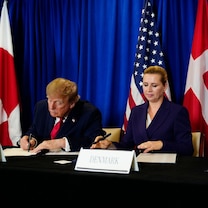
President Donald Trump attends the signing of a security pact between the U.S., Denmark, and Greenland during the 81st session of the United Nations General Assembly at U.N. Headquarters, September 22, 2026 in New York City.
Chip Somodevilla/Getty Images
The president told reporters during a bilat with Ukrainian President Volodymyr Zelenskyy, that it was a "very good meeting," and said he couldn't imagine why Iran wouldn't want to make a deal.
"It's a greatness, potential greatness or obliteration. In one case, it's obliteration. And the other alternative is potential greatness. It can be a great country," he said.
Trump later confirmed that Special Envoy Steve Witkoff or Jared Kushner were the members of his team who met with the Iranians.
"I can tell you that Steve and Jared met with the mediators on Iran deal. The mediators were here, not the highest level, but did something. A lot of good thoughts. A lot of things are working out very well," Trump said during the "Shield of the Americas" anti-cartel coalition meeting on the sidelines of U.N. General Assembly.
-ABC News' Isabella Murray, Fritz Farrow, Michelle Stoddart and Nicholas Kerr