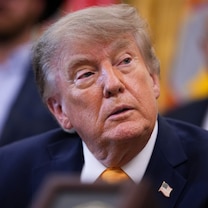
President Donald Trump announced "major combat operations" against Iran on Feb. 28, with massive joint U.S.-Israeli strikes targeting military, government and infrastructure sites.
Delegations from the U.S. and Iran entered negotiations in June aimed at a war-ending deal based on a memorandum of understanding signed by both countries.
The U.S. and Iran have nonetheless continued to exchange relatively limited strikes despite the signing of the memorandum and amid the continuation of peace talks, with the strategic Strait of Hormuz the primary flashpoint.
US to reinstate Iran blockade, charge fees in Strait of Hormuz, Trump says
President Donald Trump said on Monday that the U.S. would reinstate the naval blockade against Iranian ships and ports and would charge a 20% fee on all cargo shipped through the Strait of Hormuz.
“We are reinstating the THE IRANIAN BLOCKADE, so named because it is only stopping Iran’s ships or customers from entering or leaving,” Trump wrote on social media.
The president told Fox News earlier that the U.S. would take control of the Strait of Hormuz and get paid for protecting it, adding in his social media post that the U.S. would be the "guardian" of the strait and charge a 20% toll on cargo sent through the waterway.
Trump said that the fee would cover “any and all costs necessary to do the job of providing safety and security to this very volatile section of the World.”
-ABC News’ Emily Chang, Victoria Beaule and Nicholas Kerr
Jul 13, 2026, 9:33 AM EDT
US 'taking over' Strait of Hormuz, Trump says
President Donald Trump asserted Monday that the U.S. is "taking over" the Strait of Hormuz, asserting that he planned to run and protect the critical waterway and get paid for doing so.
"Well, we're taking over the Strait. They have nothing. They've got nothing," Trump said in a live phone interview with "Fox and Friends" following the latest exchange of strikes between the U.S. and Iran.
"We're going to keep the Strait and we'll probably run it. We'll become the guardian of the Strait. Maybe we'll call it the guardian angel of the Strait, and we should be reimbursed for that," Trump added.
The president did not say how the U.S. would be paid, though he's previously floated charging a toll on vessels transiting the strategic waterway.
Trump said the U.S. attacked Iran on Sunday night which he claimed was retribution for Iran reneging on its commitments under the memorandum of understanding signed by the combatants last month.
"We hit them very hard last night. Every time they send a drone, we hit them very hard. But we had a deal. But nobody knows we had a deal. It was a done deal. And then they broke it," the president said.
The president also claimed that there was an 11-hour meeting with Iranian representatives on Sunday and that Iran had agreed to "everything" before later proposing "changes." The president did not specify what changes Iran had proposed. Iranian representatives held talks in Oman on Saturday without U.S. diplomats present.
The White House did not immediately respond to a request for comment about the meeting.
-ABC News' Nicholas Kerr
Jul 13, 2026, 7:24 AM EDT
Oil prices creep up amid US-Iran exchanges
U.S. oil was trading at $72.83 per barrel -- up about 2% -- as of Monday morning after the latest round of exchanges between U.S. and Iranian forces. Global oil was trading at $77.52 per barrel, also up around 2%.
The national average price for a gallon of regular gas was $3.81 on Monday, according to data from GasBuddy -- up 9 cents since last week.
Traffic through the Strait of Hormuz has slowed in recent days, according to latest data from global ship tracking firm Kpler. Fourteen ships crossed through the strategic waterway on July 12, compared with 24 ships on July 11.
-ABC News' Zunaira Zaki
Jul 13, 2026, 5:15 AM EDT
US-Iran MOU in 'crisis,' Iranian official says
Iranian Foreign Ministry spokesperson Esmaeil Baghaei said during a press conference on Monday that the memorandum of understanding between the U.S. and Iran "has entered a crisis stage," following the escalation in attacks over the past week.
Baghaei argued that any points of the agreement Iran did not fulfill were a direct result of the U.S. having "violated its commitments," as quoted in a write up published by the official Islamic Republic News Agency.
Addressing rumors that weekend talks in Oman addressed broader issues, including nuclear talks, Baghaei said that the discussions "were solely focused on the issue of the Strait of Hormuz."
"Our effort was to reach a mechanism in consultation with Oman that would ensure the safe passage of ships through the Strait of Hormuz," Baghaei added. No agreement was reached, he said, because of "overt and covert pressure from the U.S. on Oman."
Cargo ships anchored near the Strait of Hormuz off the eastern coast of the United Arab Emirates at Khor Fakkan, July 12, 2026.
AFP via Getty Images
Baghaei said Iran was adhering to the Strait of Hormuz clause in the memorandum of understanding and that Tehran has the right and obligation "to take the necessary measures to protect our security and national interests," adding that the Strait and surrounding areas had been "misused to harm Iran's security and national interests."
The presence of U.S. warships escorting commercial vessels through the Strait, Baghaei said, "confirms the U.S.' insistence on continuing insecurity in the region."
Baghaei also defended Iran's ongoing attacks on neighboring countries, claiming that Iran was only targeting "the bases, facilities, and positions used by the United States to attack Iran, including its logistical and support facilities."
Among the issues still to be addressed in any final peace settlement is the scale and nature of Iran's nuclear program. Baghaei on Monday dismissed the idea that Rafael Grossi -- the director of the International Atomic Energy Agency -- would be allowed to access Iran's nuclear facilities.