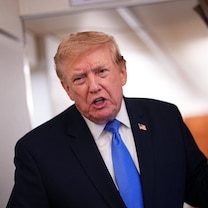
Trump says US Navy attacked and seized Iranian-flagged cargo ship

"U.S. Marines have custody of the vessel," Trump said.

Last Updated: April 19, 2026, 10:21 PM EDT

President Donald Trump announced "major combat operations" against Iran on Feb. 28, with massive joint U.S.-Israeli strikes targeting military and government sites.

After initial U.S.-Iran talks in Pakistan failed to reach a peace deal, Trump announced Sunday, April 19, that U.S. negotiators would head back to Islamabad Monday for a new round.

White House press secretary Karoline Leavitt said Vice President JD Vance would accompany special envoy Steve Witkoff and Jared Kushner, the president's son-in-law, to Islamabad for the talks.

Iran's continuing blockage of the Strait of Hormuz and their alleged refusal to abandon their nuclear program remain key sticking points in negotiations, according to Trump.

Apr 14, 2026, 6:24 AM EDT

US-sanctioned tankers pass Strait of Hormuz, tracking data suggests

The Rich Starry, one of the U.S.-sanctioned tankers that approached the Strait of Hormuz on Monday before turning around, appeared on Tuesday to have successfully transited the waterway, according to data from Kpler-owned ship tracking firm Marine Traffic and Michelle Bockmann, a shipping analyst with the maritime AI company Windward.

The tanker crossed from the Persian Gulf into the Gulf of Oman before appearing to stop just beyond the eastern mouth of the Strait. Several other ships are in the same area and transmitting as being at anchor, according to Marine Traffic.

Elpis, the U.S.-sanctioned tanker that made the crossing on Monday, also appeared to have stalled immediately after its exit at the eastern mouth of the Strait, according to Marine Traffic and Eurasia Group analyst Gregory Brew.

Marine Traffic data and Bockmann indicated that the Murlikishan -- a chemical tanker sanctioned by the U.S. in 2020 for its ties with Iran -- crossed the Strait of Hormuz heading west on Tuesday morning.

The Murlikishan crossed from the Gulf of Oman into the Persian Gulf. The vessel appeared to have already been in the Gulf of Oman when the U.S. blockade of Iranian ports in the Strait of Hormuz started on Monday.

-ABC News’ Victoria Beaule

Apr 14, 2026, 4:45 AM EDT

China says US Strait of Hormuz blockade 'dangerous and irresponsible'

Chinese Foreign Ministry spokesperson Guo Jiakun told reporters on Tuesday that the U.S. blockade of Iran's Strait of Hormuz ports "will only exacerbate tensions, undermine the already fragile ceasefire and further impact the safety of navigation."

Guo described the blockade, which began on Monday, as "a dangerous and irresponsible act."

A ship is seen off the coast of Ras al-Khaimah, the day after the failure of U.S.-Iran peace talks on April 13, 2026.
-/AFP via Getty Images

Beijing, Guo said, "believes that only a comprehensive ceasefire can fundamentally create conditions for easing tensions in the Strait of Hormuz."

"China urges all parties to abide by the ceasefire agreement, focus on the general direction of dialogue and negotiations and take concrete actions to promote regional de-escalation and restore normal navigation in the Strait of Hormuz as soon as possible," Guo said.

-ABC News' Karson Yiu

Apr 14, 2026, 3:21 AM EDT

Xi says world cannot regress to 'law of the jungle'

In a series of diplomatic meetings in Beijing on Tuesday with Spanish Prime Minister Pedro Sanchez and Abu Dhabi's Crown Prince Sheikh Khaled bin Mohamed bin Zayed Al Nahyan, Chinese President Xi Jinping voiced his concern about recent developments in the Middle East and promoted China as a responsible and stable partner.

Xi did not mention the U.S. or President Donald Trump by name while meeting either leader.

"The world today is rife with chaos and faces a contest between justice and power," Xi said while meeting Sanzhez, adding that the two nations should work together to "oppose the world's regression to the law of the jungle."

China's President Xi Jinping attends a meeting with Spain's Prime Minister Pedro Sanchez at the Great Hall of the People in Beijing, China, on April 14, 2026.
Haruna Furuhashi/via Reuters

Xi told Sanchez, "How a country treats international law and the international order reflects its worldview, view of order, values and sense of responsibility."

In his meeting with Abu Dhabi's crown prince, Xi played up China's efforts to promote peace talks and said that Beijing would continue to do so.

Xi also proposed a four-point framework for "promoting peace and stability in the Middle East."

It called for adherence to the principles of peaceful coexistence, national sovereignty, the international rule of law and the coordination of development and security.

The proposal is a regional facsimile of the Global Security Initiative that Xi unveiled in 2022 intended as an alternative to the existing U.S.-led security architecture, but which gained little traction at the time.

-ABC News' Karson Yiu

Apr 13, 2026, 11:27 PM EDT

US proposes 20-year minimum suspension on Iranian uranium enrichment: Source

The U.S. proposed a 20-year minimum suspension on Iranian uranium enrichment rather than a permanent end to enrichment amid negotiations to end the war with the country, a source familiar with the negotiations told ABC News on Monday.

The source said that in addition to the suspension, the U.S. also suggested "all kinds" of other restrictions but did not immediately elaborate on what they were.

The news comes as The New York Times reported on Monday that the U.S. had asked for a 20-year suspension, with the Iranians formally responding on Monday that they would agree to suspend enrichment for up to five years. The paper reported that the president had rejected that offer.

The White House did not respond to ABC News' request for comment on the Iranian proposal nor the president’s reaction to it.

-ABC News' Nicholas Kerr

Sponsored Content by Taboola