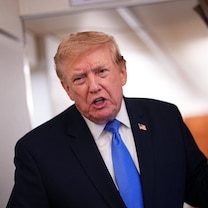
President Donald Trump announced "major combat operations" against Iran on Feb. 28, with massive joint U.S.-Israeli strikes targeting military and government sites.
After initial U.S.-Iran talks in Pakistan failed to reach a peace deal, Trump announced Sunday, April 19, that U.S. negotiators would head back to Islamabad Monday for a new round.
White House press secretary Karoline Leavitt said Vice President JD Vance would accompany special envoy Steve Witkoff and Jared Kushner, the president's son-in-law, to Islamabad for the talks.
Iran's continuing blockage of the Strait of Hormuz and their alleged refusal to abandon their nuclear program remain key sticking points in negotiations, according to Trump.
State Department says Israel and Lebanon agreed to launch direct negotiations
Following the meeting with the Israeli and Lebanese ambassadors to the U.S., the State Department said there were "productive discussions on steps toward launching direct negotiations between Israel and Lebanon."
The department said that it seeks to lock the U.S. into a mediator role -- saying negotiations between the parties can't happen "through any separate track."
The parties agreed that direct talks would happen at a "mutually agreed time and venue," the department said, but gave no further details on when and where those talks might take place.
-ABC News' Shannon K. Kingston
Apr 14, 2026, 3:18 PM EDT
Israel-Lebanon meeting wraps, Israeli ambassador to US touts progress
The meeting at the State Department between Israel's ambassador to the U.S., Yechiel Leiter, and his Lebanese counterpart, Ambassador Nada Hamadeh, wrapped after more than two hours, according to a department official.
Before departing, Leiter told reporters that he and Hamadeh had discovered during the talks that Lebanon and Israel are "on the same side of the equation" and united against Hezbollah.
He said the two had envisioned a future where the only reason to cross over each other's borders was to conduct business or go on vacation -- scenarios that would be a remarkable turn of events from the current Israeli military action in Lebanon and decades of opposition to the normalization of ties between the nations.
State Department Counselor Michael Needham, US Ambassador to the UN Mike Waltz, Secretary of State Marco Rubio, US Ambassador to Lebanon Michel Issa, Lebanon's Ambassador to the US Nada Hamadeh Moawad, and Israeli Ambassador to the US Yechiel Leiter stand together before meeting at the State Department in Washington, April 14, 2026.
Oliver Contreras/AFP via Getty Images
Leiter stressed that Israel would not compromise on the security of its citizens and said Hamadeh had emphasized that Lebanon would no longer be occupied by Hezbollah.
Leiter did not suggest Israel would abandon its campaign against the Iranian proxy, saying, "It's imperative that there’s a complete de-linkage between Lebanon and Iran. Iran is the malign influence in the region and around the world, and Hezbollah is their proxy next to Israel."
Regarding a possible treaty with Lebanon, Leiter said that "we are working on the agreement on every front," but that "the security issue" would have to be resolved before there could be anything like the diplomatic agreements between Israel and other Abraham Accord countries.
Leiter did not discuss plans to fully disarm Hezbollah but said that Israel's action against the group had enabled Lebanon's government to take "bold" actions -- citing the direct talks that took place today as an example.
-ABC News' Shannon K. Kingston
Apr 14, 2026, 1:09 PM EDT
State Department announces reward for info on Kata'ib Hezbollah leader
The State Department's Rewards for Justice program announced Tuesday it would pay out up to $10 million for information on Ahmad al-Hamidawi, the leader of Kata'ib Hezbollah -- a U.S.-designated foreign terrorist organization closely aligned with Lebanese Hezbollah that is considered to be the most powerful militia in Iraq.
The department said al-Hamidawi directed Kata'ib Hezbollah attacks on U.S. diplomatic facilities last month, and that for years the group has "repeatedly targeted U.S. personnel and facilities in Iraq with IEDs, rockets, and unmanned aircraft systems, kidnapped U.S. citizens, and killed innocent Iraqi civilians."
Al-Hamidawi received "political, military, and intelligence training from Iran’s Islamic Revolutionary Guard Corps," the release stated.
Half of Americans say military action in Iran not worth it: Poll
A new poll from Ipsos found that half (51%) of Americans say the decision to take military action in Iran has not been worth it. Another 24% say it has been worth it and 22% are unsure.
The poll found that 54% say the military action the U.S. has taken in Iran has had a mostly negative impact on their personal financial situation, while 29% say it has not had an impact.
On long-term U.S. security, the poll found that 41% of Americans think it will get worse due to the military action in Iran, 26% think it will improve, and 29% say it will not have an impact either way.
The poll, conducted from April 10 to 12, found that 60% of Americans disapprove of the U.S. military strikes against Iran and 35% approve -- little changed from when Ipsos last asked earlier this month and throughout March.