Russian President Vladimir Putin's "special military operation" into neighboring Ukraine began on Feb. 24, with Russian forces invading from Belarus, to the north, and Russia, to the east. Ukrainian troops have offered "stiff resistance," according to U.S. officials.
The Russian military has since launched a full-scale ground offensive in eastern Ukraine's disputed Donbas region, capturing the strategic port city of Mariupol and securing a coastal corridor to the Moscow-annexed Crimean Peninsula.
Here's how the news is developing. All times Eastern.
Jun 23, 2022, 6:08 AM EDT
Belarusian military flexes its muscle near Ukrainian border
The Belarusian Defense Ministry announced “mobilization exercises” on Wednesday in the Gomel region bordering Ukraine.
The military drills, scheduled to last until July 1, will include special operations forces as well as freshly called up conscripts, Belarusian officials said on Telegram.
The Belarusian army has already been placing wooden dummies of tanks on the Ukrainian border to demonstrate their presence, Ukrainian Ministry of Defense spokesperson Alexander Motuzyanyk said on Wednesday.
Real weapons are arriving near the Ukrainian border, too, with a new batch of Russian missiles for the S-300 anti-aircraft missile system being brought to Belarus on Tuesday night, local monitoring groups reported. The delivery included at least 16 missiles, with the likely addition of one Pantsir missile defense system, the report said.
Still, Ukrainian officials maintain that “at this stage of the war,” there is no imminent threat “of the Belarusian army invading” Ukraine, Kyrylo Budanov, head of the Main Intelligence Directorate, said on Wednesday as cited by local media.
-ABC News' Edward Szekeres, Max Uzol, Fidel Pavlenko and Yuriy Zaliznyak
Jun 23, 2022, 5:39 AM EDT
EU shifts to coal as Russia tightens gas tap
The European Union will temporarily shift back to coal to cope with slowing Russian gas flows, an EU official said on Wednesday, as a tight gas market and rocketing prices set off a race for alternative fuels.
"The unlawful invasion by Russia of Ukraine has resulted in an emergency situation in the EU," Elina Bardram, acting director for International Affairs and Climate Finance at the European Commission, told the Africa Energy Forum in Brussels, according to Reuters.
Bardram said the administration of Russian President Vladimir Putin was making “rogue moves” as Gazprom, the Russian state-controlled gas exporter, continued its policy of “lowering the flow [of gas] very suddenly.”
The Industrial Park of Hoechst is pictured in Frankfurt, Germany, June 23, 2022. Germany activated the second phase of its three-stage emergency plan for natural gas supplies saying the country faces a “crisis.”
Michael Probst/AP Photo
“We are taking some very important measures, but all of those measures are temporary," the EU official added, referring to the bloc's increasing coal use.
The International Energy Agency warned Russia could cut gas supplies to Europe completely this winter.
“Europe should be ready in case Russian gas is completely cut off,” IEA chief Fatih Birol told The Financial Times on Wednesday.
While Russia denies premeditated supply cuts, several European countries, including Germany and Italy, reported a dip in gas flow via pipelines from Russia over the past week.
-ABC News' Edward Szekeres, Max Uzol, Fidel Pavlenko and Yuriy Zaliznyak
Jun 22, 2022, 7:31 AM EDT
Turkey raises hopes for grain exports
A four-way summit discussing ways to export grain blocked in Ukraine will be held in Istanbul in less than 10 days, Turkish presidential sources told local media on Tuesday.
According to Turkish officials, a military delegation will head to Russia this week to discuss details. On top of Russian and Ukrainian delegations, Turkish President Recep Tayyip Erdoğan and the UN Secretary General António Guterres are likely to attend the Istanbul summit, local sources said.
The lives of about 400 million people in different countries depend on Ukrainian food exports, Ukrainian President Volodymyr Zelenskyy said on Monday.
-ABC News' Edward Szekeres, Tatiana Rymarenko, Fidel Pavlenko and Natalya Kushnir
Jun 22, 2022, 6:20 AM EDT
Russia escalates provocations as US reassures allies
Estonia, a NATO member, summoned the Russian ambassador on Tuesday in protest of an “extremely serious” violation of its airspace by a Russian helicopter, Reuters reported.
The Estonian military and foreign ministry said in a statement on Tuesday that a Russian border guard MI-8 helicopter had flown over a point in the country’s southeast without permission on June 18.
The helicopter was in Estonia’s airspace for almost two minutes, Estonia’s military said, adding that the helicopter had not presented a flight plan, had its transponder switched off, and failed to maintain radio contact with Estonian Air Navigation Services.
"Estonia considers this an extremely serious and regrettable incident that undoubtedly causes additional tensions and is completely unacceptable," the foreign ministry said in a statement. The alleged intrusion was the second violation of Estonia's airspace this year. According to Estonian officials, Russian troops are also simulating daily missile strikes on Estonia.
"It's never been as serious as it is now. It's real life. They're actually mimicking missile strikes on NATO territory and letting us know they're doing it," Kusti Salm, the chief of staff of the Estonian Defense Ministry, said.
In its statement, the Estonian Foreign Ministry also repeated calls for Russian troops to leave Ukraine.
"Russia must stop threatening its neighbors and understand that the price of the aggression Russia launched against Ukraine is indeed high," it added.
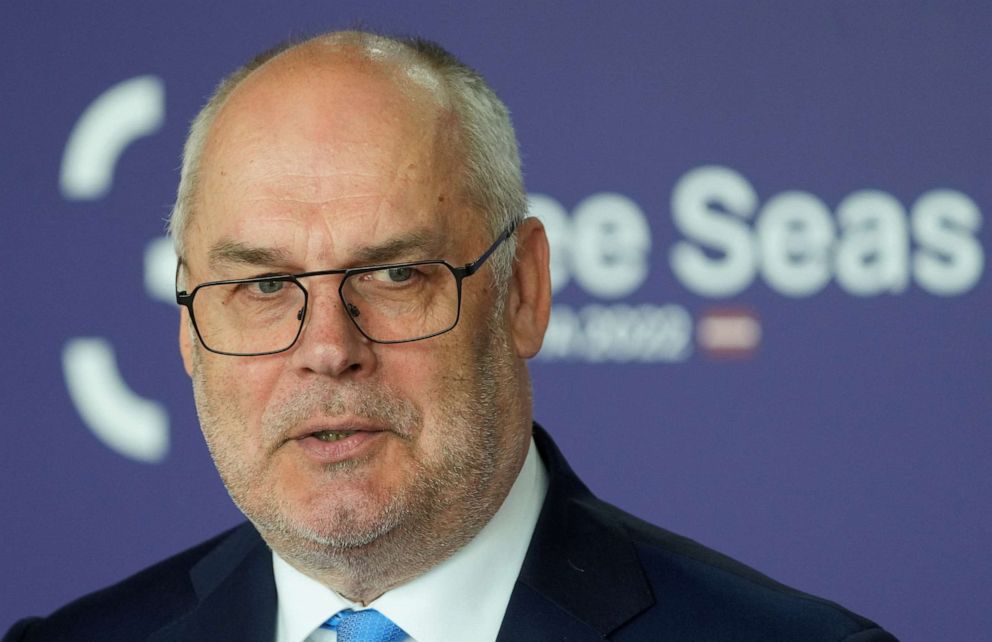
Estonian President Alar Karis attends the Three Seas Summit in Riga, Latvia, June 20, 2022.
Ints Kalnins/Reuters
Estonia did not forget to express solidarity with fellow Baltic and NATO nation Lithuania, which Moscow says will be punished for banning the transit of some goods to the Russian exclave of Kaliningrad.
The U.S. stated on Tuesday that NATO's obligations to Lithuania are "ironclad" in the face of Russia's threats. “We stand by our NATO allies and we stand by Lithuania,” State Department spokesman Ned Price said at a press conference.
“Specifically our commitment to NATO’s Article Five — the premise that an attack on one would constitute an attack on all — that commitment on the part of the United States is ironclad,” Price added.
Amid U.S. reassurances, President Joe Biden scored an 89% approval rating in Ukraine according to a local poll published on Monday. British Prime Minister Boris Johnson shares the highest approval rating in Ukraine with Polish President Andrzej Duda, with both polling at 90%.
German Chancellor Olaf Scholz recorded the lowest approval among major leaders with a 41% rating. Hungarian Prime Minister Viktor Orban, who refused to supply Ukraine with weapons and has been equivocal about his condemnation of Russian President Vladimir Putin in the wake of Russia's invasion of Ukraine, scored a negative rating in the poll.
The research also revealed a vast majority of Ukrainians (89%) supporting the idea of joining the European Union, with 69% believing that Ukraine could join the bloc in five years. A further 76% of Ukrainians said they back their country's NATO membership.