Nepal's prime minister resigns as social media ban reversed amid violent protests
Prime Minister KP Sharma Oli blamed "external infiltrators" for violence.
LONDON -- Nepal's Prime Minister KP Sharma Oli resigned on Tuesday after a social media ban sparked violent protests in which at least 19 people died on Monday.
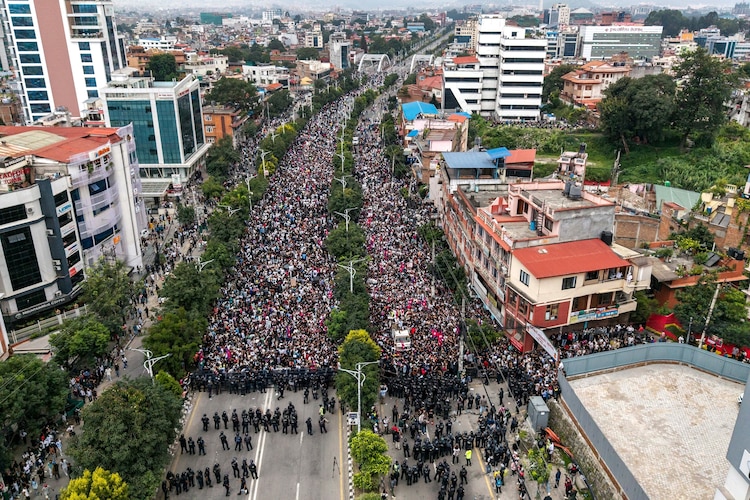
Even after the government's social media restrictions were rolled back, the protests continued on Tuesday in Kathmandu, the capital, were protestors were reportedly setting homes of political leaders on fire.
Oli had earlier blamed "external infiltrators" for violence.

The homes of several politicians -- including Sher Bahadur Deuba, leader of the largest party Nepali Congress; President Ram Chandra Poudel; Home Minister Ramesh Lekhak and leader of the Communist Party of Nepal Maoist Pushpa Kamal Dahal -- were set on fire, The Associated Press reported.
The Monday clashes left 19 dead and 421 injured, according to the government. An indefinite curfew was put in place in the capital and Tribhuvan Airport has been shut down, with all flights cancelled.

"I'm protesting. I didn't like it. I hate it. I'm opposing it!" Rajendra Bajgain, a member of parliament, told ABC News after Monday's protests.
The protests began after the government decision to ban social media platforms, including Facebook, WhatsApp and YouTube. That ban was seen by many as an attack on freedom of speech -- and an extension of what some described as the government's corrupt nature.
"Ministers are corrupt. They are doomed with the PM," Bajgain said prior to the prime minister's resignation. "Listen to me very clearly, very loudly: if [the prime minister] continues the ban, he's going to finish in a couple of days."
In a statement released on Sept. 4, Committee to Protect Journalists Regional Director Beh Lih Yi said that the ban would essentially be "blocking online news platforms vital to journalists [and] will undermine reporting and the public's right to information."
The so-called "Gen-Z protests," which were in-part organized by Hami Nepal, a nonprofit your group, began with a demonstration on Monday morning in Maitighar, a Kathmandu neighborhood less than a mile from the federal parliament building. Within a couple hours, the protestors were moving toward the federal parliament building.

The situation escalated after the Nepali Government announced a curfew as protesters tried to enter parliament compound in New Baneshwor, Kathmandu.


To stop the protestors, security officers started with water cannons, and then resorted to tear gas, according to local media. Eventually, the Nepali army was deployed to contain the situation.
On Monday evening, Home Minister Ramesh Lekhak resigned, saying he was taking responsibility for the situation, which by then had turned into violent protests.
Dr. Badri Rijal, chief medical superintendent at National Trauma Center, told ABC News that 56 people who were injured on Monday remained hospitalized. Five other hospitals also have injured protestors, he said.
Raj Chettri, general manager of Kathmandu Airport, said on Tuesday the airport was shut down around 9 a,m. local time after a security alert near the perimeter.
"Now, no flights are coming in or going out," Chettri said.
Chettri said a few flights that were already approaching were allowed to land, while "a couple of departures" took off earlier -- one heading west."
"I think the flight that has taken off, it carried leaders, but I don't know for sure," Chettri said. "A few helicopters have landed at Kathmandu airport -- they have carried leaders."
He said he expected the airport to reopen "soon."
Related Topics

Popular Reads
ABC News Live