Jamaica struggles to recover a year after Hurricane Melissa hit as peak tourism season looms
Jamaica’s once flourishing tourism sector is struggling to regain its footing nearly a year after Hurricane Melissa slammed into the island as a Category 5 storm
KINGSTON, Jamaica -- Jamaica’s once flourishing tourism sector is struggling to regain its footing nearly a year after Hurricane Melissa slammed into the island as a Category 5 storm.
High deductibles and delays in insurance claim settlements mean that hotels and other businesses are running out of operating capital as Jamaica’s peak winter travel season approaches.
An estimated 20 hotels remain closed nearly a year after Melissa hit, killing dozens of people and causing an estimated $12 billion in damage, much of it in the island’s northwest region.
Tourism represents up to 35% of Jamaica’s GDP. It also accounts for more than half of the country’s total foreign exchange earnings and employs roughly one in four workers when indirect jobs are factored in.
The greatest hurdle to full recovery of the tourism sector isn’t the availability of construction materials or labor; it’s a mounting insurance crisis characterized by severe payout delays, massive deductions and a crippling cash shortfall.
“Claims are being paid slowly and settled short, and that leaves a working-capital hole across the sector,” said O’Brian Heron, president of the Jamaica Hotel and Tourist Association.
According to the association, more than 61% of claimants are awaiting full settlements, leaving operators struggling to finance their own rebuilding efforts.
More than eight in 10 association members submitted a property or business interruption claim after the hurricane, underscoring the widespread impact on the sector.
Despite the insurance industry’s public commitment to resolve the bulk of non-litigated claims by the end of September, this has not happened.
“The evidence from our members shows how far there is still to go,” Heron said.
Damages from the hurricane are the equivalent of roughly 57% of Jamaica’s GDP, and the physical and economic scars of the storm are profound.
Commercial claims filed by Jamaica’s hospitality sector make up the bulk of the island’s projected $2.2 billion to $4.2 billion in total private insured losses.


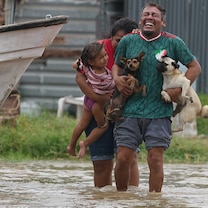
The disruption to room stock caused a 17% drop in visitor arrivals and an 18% drop in tourism revenue, costing the country roughly $550 million in lost earnings.
Tourism stakeholders argue that the problem is how claims are being processed and undervalued. According to Jamaica’s Hotel and Tourism Association, seven in 10 claimants reported facing deductions that exceed what they understood their policies allowed under the controversial “average clause” — a provision that penalizes policyholders if a property is deemed underinsured. For nearly a third of claimants, these deductions have slashed the value of their claims by more than 40%.
“Complexity is not an acceptable excuse for delay, still less for silence, and it does not justify deductions beyond the policy terms,” Heron said.
Insurers have blamed the delays on the complex nature of commercial hotel claims and a severe shortage of licensed property adjusters in Jamaica. They point out that fewer than half the number of loss adjusters registered with the Financial Services Commission are licensed to handle property claims, leading to a severe backlog. Furthermore, calculating lost revenue from closed resorts for business interruption claims can take months.
“Members advise that insurers are unilaterally revaluing property and assets above the values previously accepted in the policy, and then deeming those properties underinsured,” Heron explained.
Everton McFarlane, executive director of the local organization that represents insurers, the Insurance Association of Jamaica, said the concerns are understandable given the significance of tourism to the economy. But he said insurers can’t just settle claims because of pressure from certain clients. He said this would have implications for the insurers as well as reinsurers, which are based outside of Jamaica.
McFarlane was unable to comment directly on the complaints about the delayed settlements and excessive deductibles, saying that each claim had to be assessed individually. He stressed the complexity of assessing each claim, noting that insurers derive no benefit from prolonged and unsettled claims.
The slow pace of the insurance payouts has caught the attention of government officials.
Prime Minister Andrew Holness recently warned that he might use legislative authority to force faster resolutions, as the delay remains a massive roadblock to national economic recovery.
“Paying up the insurance is critical to the national recovery,” he said.
Related Topics

Popular Reads
ABC News Live