Highlights from Senate vote to confirm Ketanji Brown Jackson

The Senate voted 53-47 in a bipartisan vote on Jackson's nomination.

Last Updated: April 7, 2022, 5:29 PM EDT

Judge Ketanji Brown Jackson, the first Black woman nominated to the U.S. Supreme Court in its 233-year history, was confirmed by the Senate in a 53-47 vote Thursday.

She got three Republican votes, marking a bipartisan victory for President Joe Biden and his high court nominee.

Mar 22, 2022, 8:05 PM EDT

Jackson gets emotional talking about family

Sen. Cory Booker, D-N.J., defended Jackson after she was grilled by Republicans over sentencing, saying that "line of attack… doesn't hold water."

"I was a little insulted about the accusation that somehow, this mother of two, confirmed three times by the United States Senate, who has victim advocacy groups writing letters for … that somehow the implication that you are somehow out of the norm of other federal judges that we have confirmed …this implication that somehow your thoughtfulness on these very dense, fact-specific cases, is somehow out of norm, to me, does not hold up -- doesn't hold water," he said.
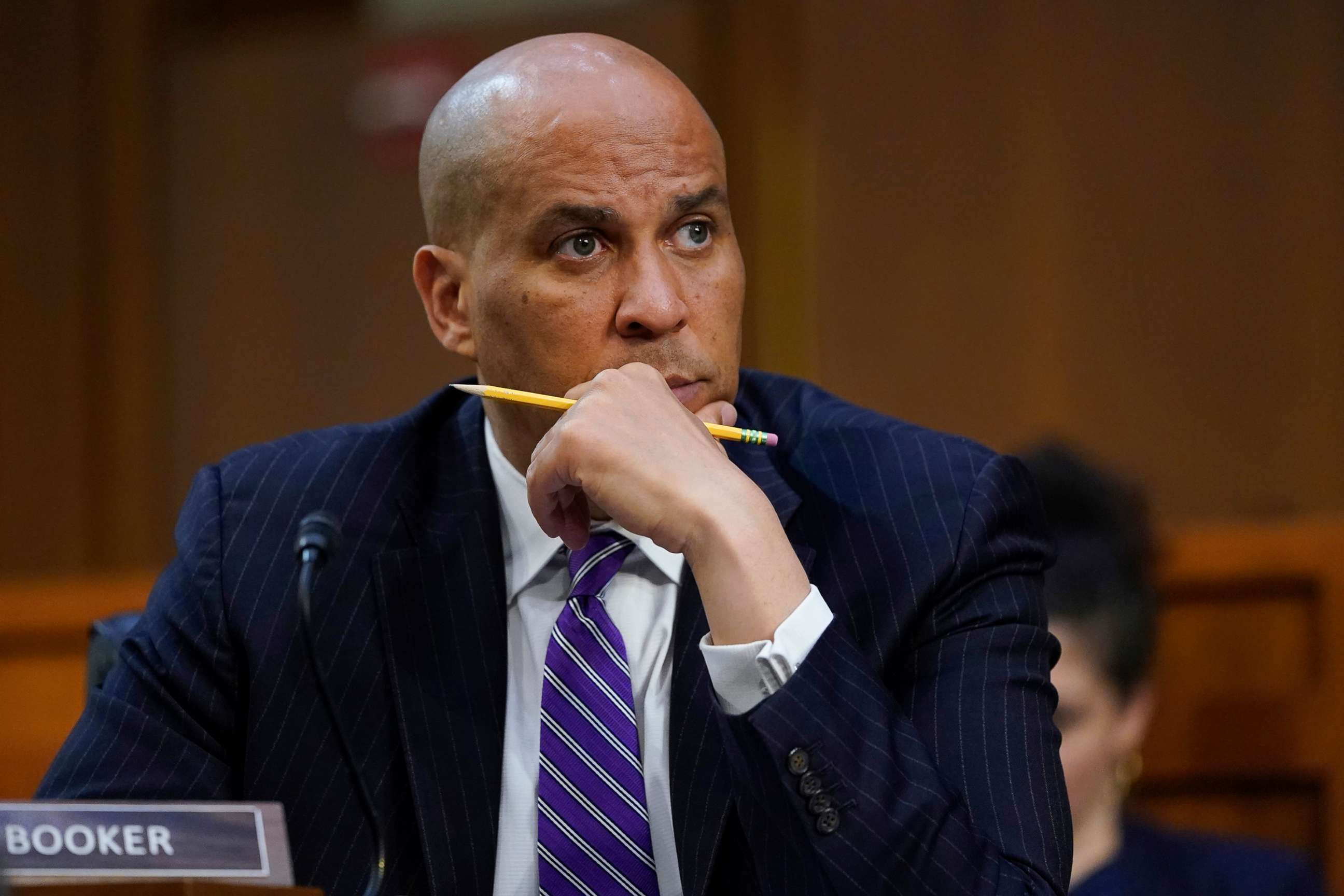
Sen. Cory Booker listens as Supreme Court nominee Ketanji Brown Jackson testifies during her Senate Judiciary Committee confirmation hearing on Capitol Hill in Washington, March 22, 2022.
Alex Brandon/AP

As Jackson's parents looked on, Booker said he wanted America to know more about Jackson's character and asked her to share about the values she's inherited from her parents.

Jackson got emotional as she spoke about her family, recounting how her parents were the first in their families to attend college. They "taught me hard work. They taught me perseverance. They taught me that anything is possible in this great country," she said.
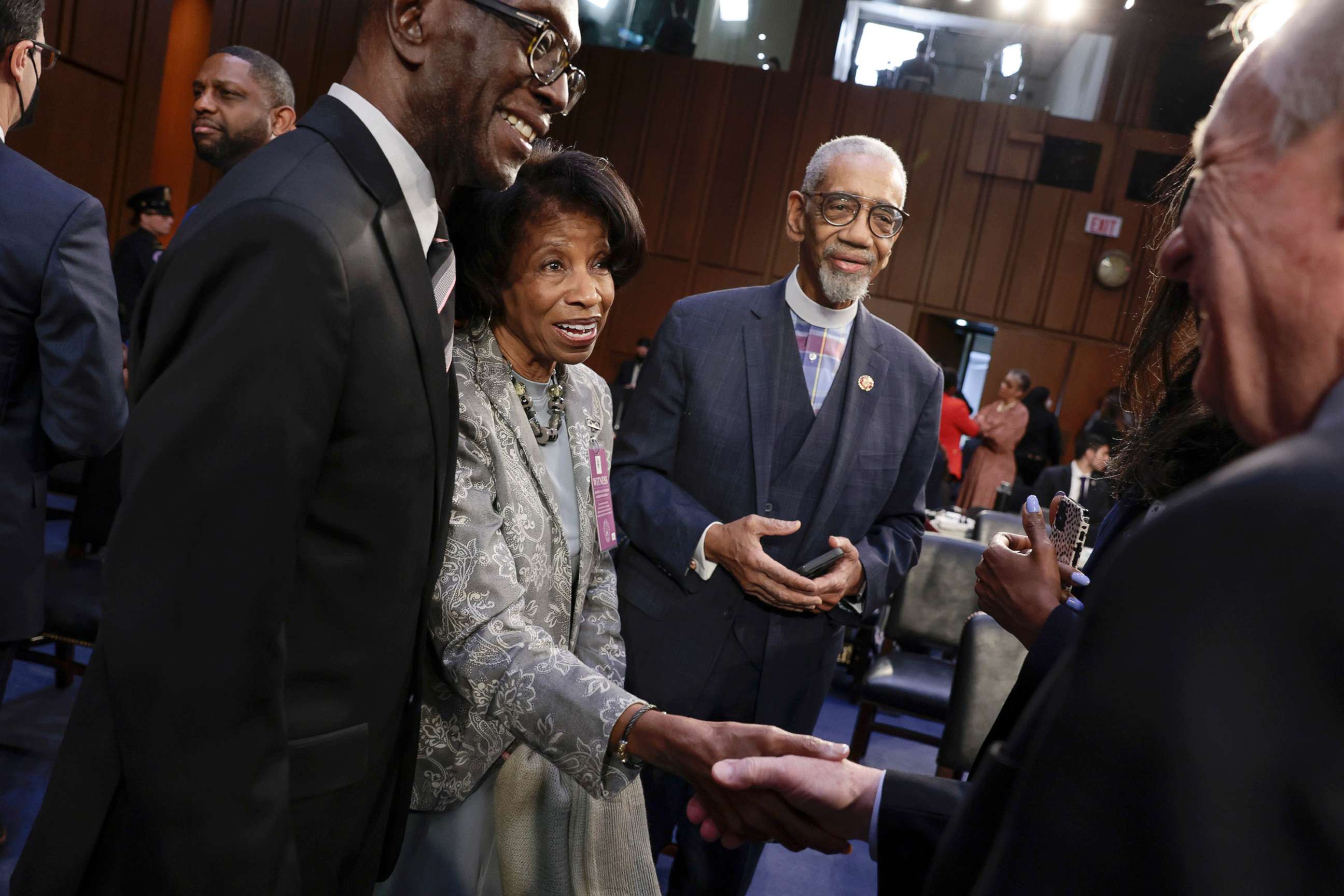
Senate Judiciary Chairman Richard Durbin greets Ellery and Johnny Brown, the parents of U.S. Supreme Court nominee Judge Ketanji Brown Jackson in Washington, March 22, 2022.
Anna Moneymaker/Getty Images

She said her parents became "extraordinary public servants" because they wanted to give back to their community. And that they raised her in Washington, D.C., "on that hope and dream," "born here with an African name."

Booker also touched on Jackson's faith, asking her, "Where do you get the grit and guts to get back up and keep on going?"

Jackson responded by talking about her grandparents, who she said "didn't have it easy."

They "didn't have a lot of formal education," but "were the hardest working people I've ever known and got up every day and put one foot after the other and provided for their families and made sure their children went to college, even though they never had the opportunities," Jackson said.

"I stand on the shoulders of people from that generation," she said. "And I focus, at times, on my faith when I'm going through hard times. ... I think that's a common experience of Americans -- that when you go through difficult times you lean into family and you turn to faith."
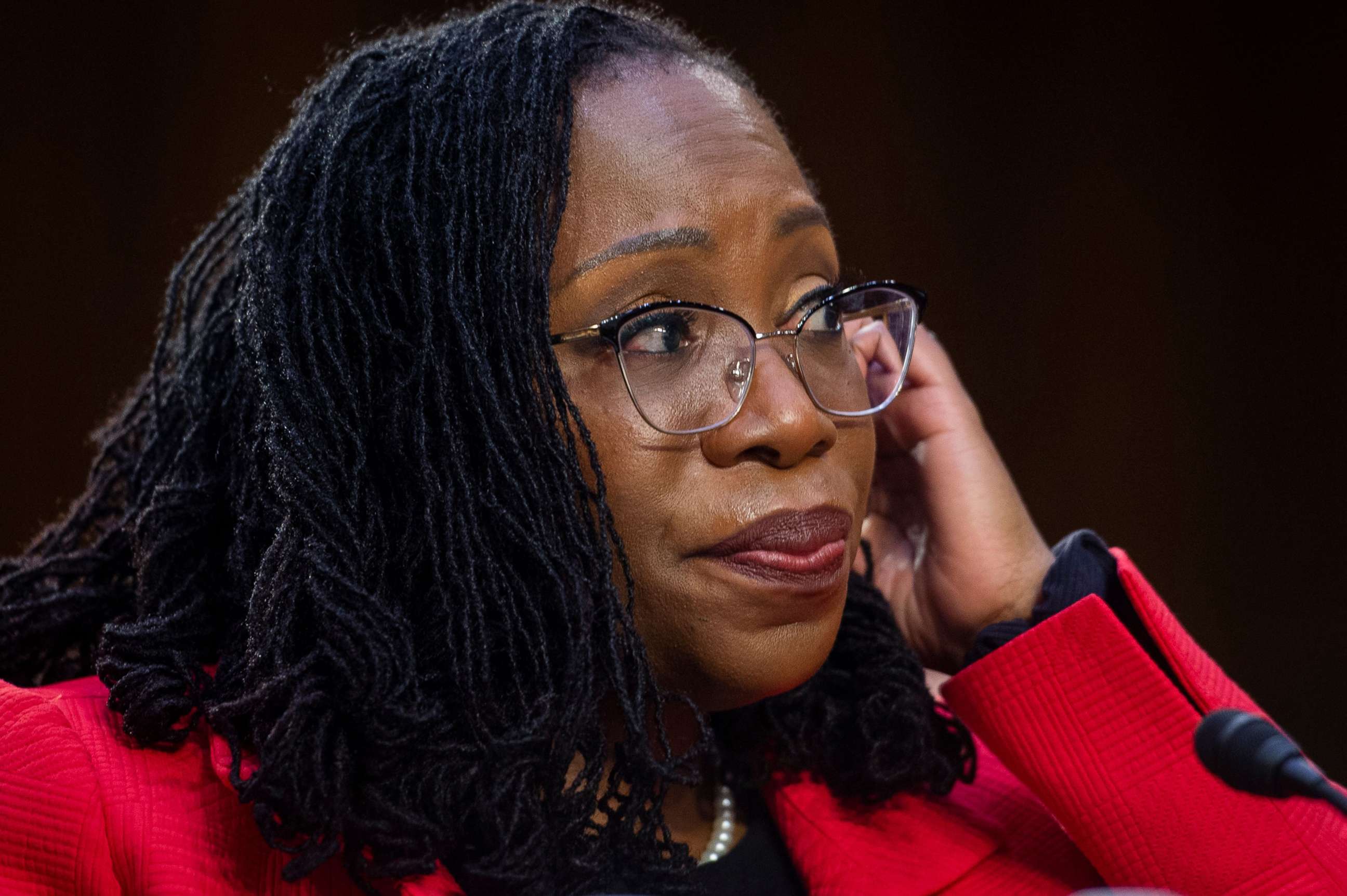
Judge Ketanji Brown Jackson appears for the second day of her Senate nomination hearings to be an Associate Justice of the Supreme Court of the United States, in the Hart Senate Office Building in Washington, March 22, 2022.
Shutterstock

Her voice shaking, she talked about the difficulties she's faced as a mom.

As a judge, she said, "There will be hearings during your daughters' recitals, emergencies on birthdays."

"I didn't always get the balance right," she said, adding that she hopes her daughters "can know that you don't have to be perfect in your career trajectory and you can still end up doing what you want to do."

Mar 22, 2022, 7:33 PM EDT

Cotton pushes Jackson on crime

Sen. Tom Cotton, R-Ark., who is considered a presidential hopeful, questioned Jackson on crime, continuing a GOP focus on crime and punishment that some see being more about political calculations than the nominee herself.

He first pushed her to answer if she believes the U.S. needs more or fewer police, calling it a "simple either/or question."

She responded, "Determination whether there should be more police is a policy decision by another branch of government. It is not something that judges have control over and I will stay in my lane in terms of the kinds of things that are properly in judiciary branch."

Cotton, appearing frustrated, said to the judge, "OK, you don't want to address it, we'll move on."

Sen. Tom Cotton listens as Supreme Court nominee Ketanji Brown Jackson testifies during her Senate Judiciary Committee confirmation hearing on Capitol Hill in Washington, D.C., March 22, 2022.
Alex Brandon/AP

Cotton asked more specific questions on crime, including if the average murder sentence -- which he said is 17 years -- is too long or too short.

Jackson responded, "Senator, these are policy questions ... They're not the kind of things I can opine about."

When Cotton asked her about rape sentences, Jackson responded, "Rape is not a crime in the federal system that I'm familiar with working with."

Cotton asked: "In 2020 alone well over 1 million -- 1 million -- violent crimes went unsolved in America. Do you think we imprison too many violent criminals or not enough?"

Jackson responded, "Senator, it's important for our rule of law to ensure that people are held accountable who are breaking the law in the ways that you mention and otherwise."

Cotton then asked her what she thought the families of the victims of unsolved crimes think.

The judge responded, "I know what the families of law enforcement officers think because I'm one of them. I know what crime does to our society. I care deeply about public safety, and as a judge, it's been my duty, when I was at the trial level … to ensure that people are held accountable for their crimes."

Supreme Court nominee Ketanji Brown Jackson testifies during her Senate Judiciary Committee confirmation hearing on Capitol Hill in Washington, D.C., on March 22, 2022.
Alex Brandon/AP

Cotton, also brought up child pornography, as other Senators have, asking if she thinks the U.S. strengthen or weaken sentences in child porn cases.

Jackson, who has repeatedly pushed back on sentencing questions by referring to the role of Congress, did so again.

"That's not a simple question," she said. "The reason is because what this country does in terms of penalties is in Congress' province -- you all decide. You all decide what the penalties are. You decide what the factors are that judges use to sentence."

Cotton also asked about a specific drug case Jackson oversaw in which the defendant received a 20-year sentence and later applied for compassionate release. Cotton accused Jackson of rewriting the law and being sympathetic to a drug kingpin.

Jackson responded, "Respectfully, Senator, I disagree. Congress provided judges, through the compassion release motion mechanism, with the opportunity to review sentences. ... In [the defendant] Mr. Young's case, the question was, with this compassionate release motion, under a circumstance in which Congress had changed the law, was that an extraordinary and compelling circumstance to revisit his sentence? And I made a determination that it was."

"What I determined under those circumstances is that I would resentence Mr. Young to the penalty that Congress had decided was the appropriate penalty for the conduct that he committed as of the time of his motion," she said.

Mar 22, 2022, 5:53 PM EDT

Hawley attacks Jackson over child porn sentencing

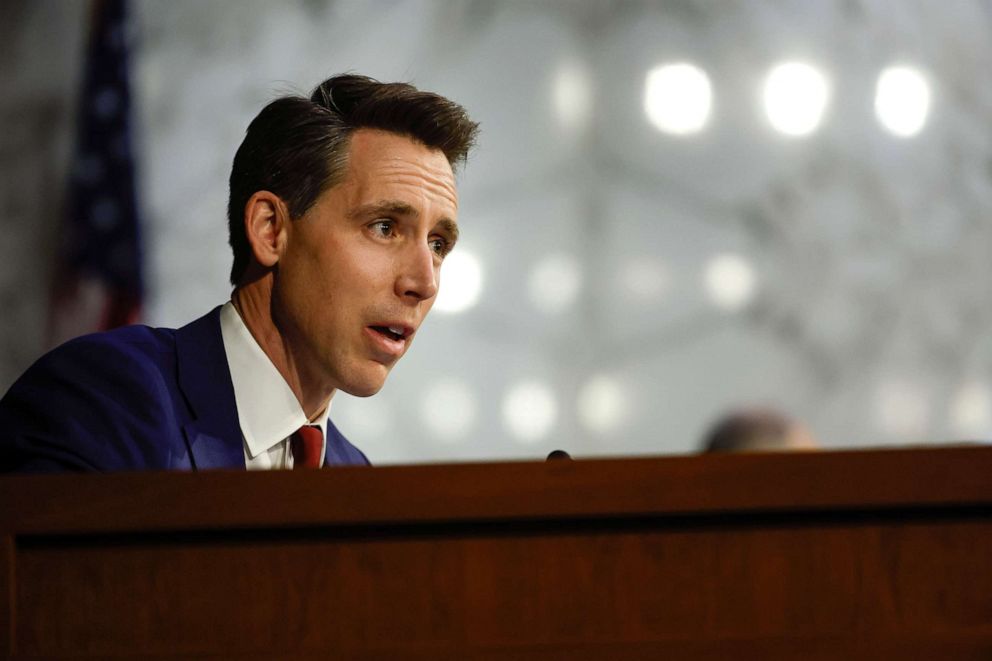
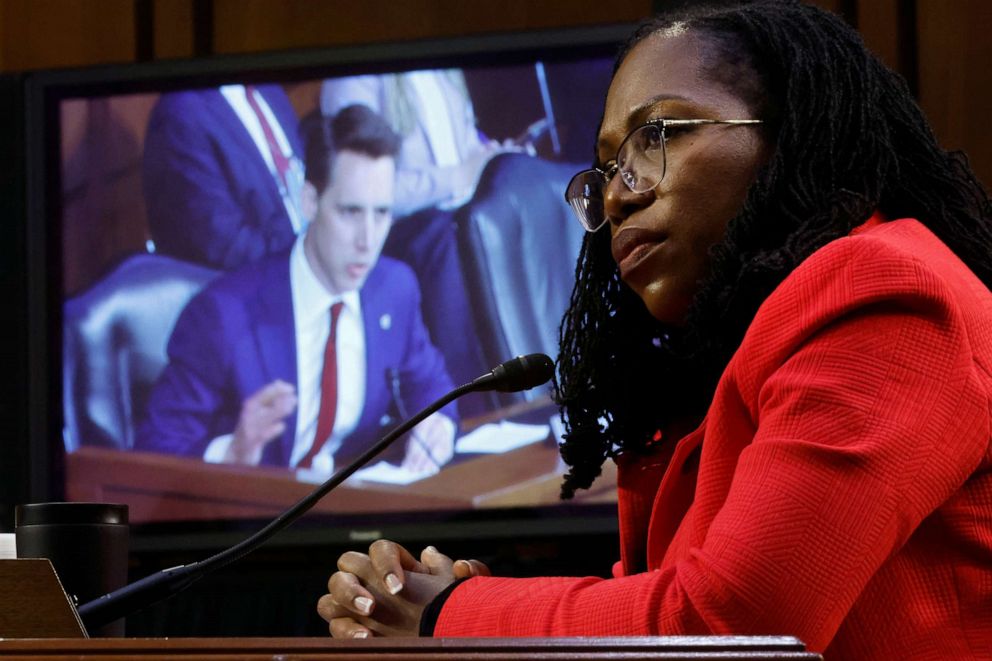
Sen. Josh Hawley, R-Mo., spent his entire 30 minutes of questioning to again accuse Jackson of giving short sentences to child porn offenders, saying he questioned her judgment. Hawley brought up a specific case involving an 18-year-old defendant who Jackson sentenced to three months in federal prison. The government had requested 24 months in prison.

"I'm having a hard time wrapping my head around it," Hawley said. "We're talking about 8-year-olds, 9-year-olds, 11-year-olds, and 12-year-olds [as victims]. He's [the defendant] got images that added up to over 600 images, gobs of video footage … If it's not heinous or egregious, how would you describe it?"

Sen. Josh Hawley questions U.S. Supreme Court nominee Judge Ketanji Brown Jackson during her Senate Judiciary Committee confirmation hearing in the Hart Senate Office Building on Capitol Hill, March 22, 2022 in Washington, DC.
Chip Somodevilla/Getty Images

Jackson responded, "The evidence that you are pointing to … is heinous. It is egregious. What a judge has to do is determine how to sentence defendants proportionately, consistent with the elements that the statutes include with the requirements that Congress has set forward. Unwarranted sentencing disparities is something that the Sentencing Commission has been focused on for a long time in regard to child pornography offenses."

"All of the offenses are horrible. All of the offenses are egregious," she continued. "But the guidelines -- as you pointed out -- are being departed from even with respect to the government's recommendation. The government in this case and in others has asked for a sentence that is substantially less than the guideline penalty. And so what I was discussing was that phenomenon, that the guidelines in this area are not doing the work of differentiating defendants as the government itself indicated in this very case. And so that's what I was talking about, but I want to assure you, Senator, that I take these cases very seriously."

Supreme Court nominee Judge Ketanji Brown Jackson answers questions from Sen. Josh Hawley during her confirmation hearing before the Senate Judiciary Committee in the Hart Senate Office Building on Capitol Hill March 22, 2022 in Washington, DC.
Chip Somodevilla/Getty Images

But she added: "It's not just about how much time a person spends in prison -- it's about understanding the harm of this behavior. It's about all of the other kinds of restraints that sex offenders are ordered, rightly, to live under at the end of the day. The sentences in these cases include not only prison time, but restraints on computer use, sometimes for decades. Restraints on ability to go near children, sometimes for decades. All of these things judges consider in order to effect what Congress has required -- which is a sentence that's sufficient but not greater than necessary to promote the purposes of punishment."

Mar 22, 2022, 5:00 PM EDT

Blumenthal: Jackson will make court 'think more like America'

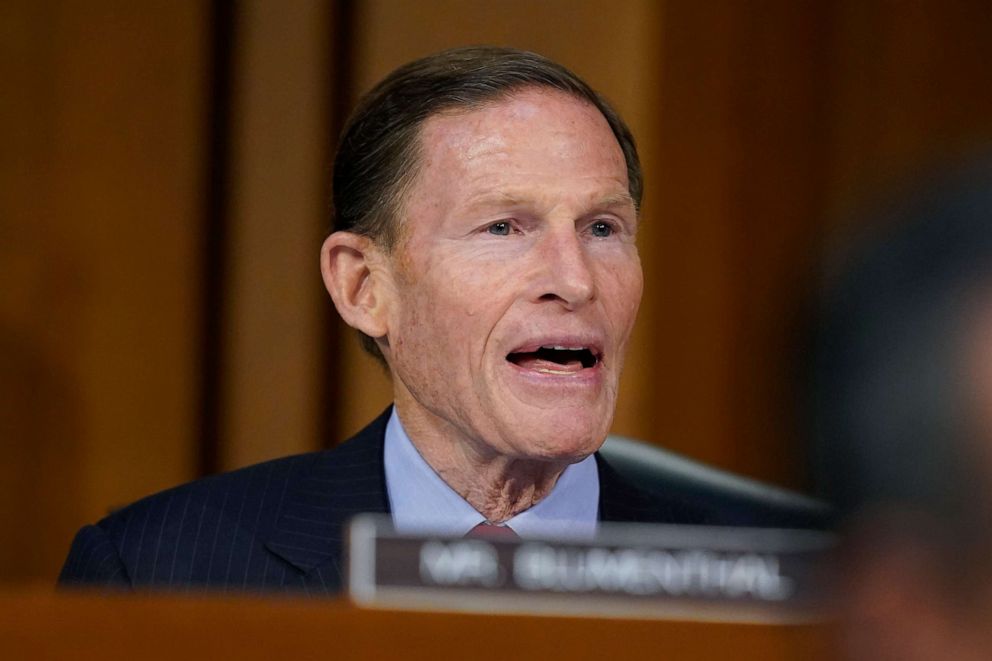
Sen. Richard Blumenthal, D-Conn., told Jackson, "As I look at your parents and your husband and your daughters, what I see is America. And the best of America. So I think we should all feel that excitement and pride in this moment."

Sen. Richard Blumenthal questions Supreme Court nominee Ketanji Brown Jackson during her Senate Judiciary Committee confirmation hearing on Capitol Hill in Washington, March 22, 2022.
Alex Brandon/AP

"You will make the court look more like America, but also think more like America," Blumenthal continued. "You will provide a very important perspective -- indeed, a unique perspective -- that the court needs more than ever at this moment in its history."

He also commended Jackson's "emotional intelligence."

"There are a lot of people who are book smart -- there are not as many people who are person smart, and you are both. That kind of emotional intelligence is what our courts need," he said.

Jackson responded: "I am humbled and honored to have the opportunity ... I stand on the shoulders of generations past who never had anything close to this opportunity, who were the first and the only in a lot of different fields. My parents, as I said, were the first in their families to have the chance to go to college. I've been the first and the only in certain aspects of my life, so I would say that I agree with you that this is a moment that all Americans should be proud."

Related Topics

Sponsored Content by Taboola