Judge Ketanji Brown Jackson, the first Black woman nominated to the U.S. Supreme Court in its 233-year history, was confirmed by the Senate in a 53-47 vote Thursday.
She got three Republican votes, marking a bipartisan victory for President Joe Biden and his high court nominee.
In a light-hearted moment, when Sen. Alex Padilla, D-Calif., began his questioning, Jackson acknowledged it is his birthday.
Padilla's first question for Jackson was why she wants to join the Supreme Court.
She said, "I came to love the law starting as early as 4 years old watching my dad study when he went back to law school when I was a child."
"I would just be so honored to have the opportunity to use my time and talents in this way," she said.
Padilla asked about Jackson's clerkship experience and if she thinks there should be a more diverse pool of law clerks.
Jackson clerked for three federal judges, including Supreme Court Justice Stephen Breyer, whose seat she is nominated for.
As a clerk, she said, "I got to understand how judges think as they evaluate cases, which for a young lawyer is an extraordinary training opportunity."
"I know how important it is for people to see that people like me are in the judicial branch … it's been part of my practice to go to schools, to reach out to young people, to tell them about clerking, to try to get them to apply," she said. "I think it's to the benefit of us all to have as many different law students seeking clerkships as possible."
Mar 22, 2022, 9:06 PM EDT
Kennedy asks about court packing
Sen. John Kennedy, R-La., asked Jackson if she believes efforts to pack the Supreme Court delegitimize it, to which Jackson responded, "I feel so strongly about ensuring that judges remain out of political debates."
Kennedy accused her of dodging the question, but Jackson said she doesn't have a strong opinion on the issue and it wouldn’t be appropriate for her to comment on it.
Kennedy kept pressing, asking Jackson if she'd be OK if the Supreme Court had 28 justices.
"If that’s Congress' determination -- yes. Congress makes political decisions like that," she said.
Kennedy also asked about what judicial restraint means to her.
Jackson said one example is adhering to precedent, which she said "is something that I do, and even in cases … in which they're not binding precedents."
"I find that the court needs to take into consideration what has previously been determined and not be a policy maker in my decisions," she said.
Mar 22, 2022, 8:05 PM EDT
Jackson gets emotional talking about family
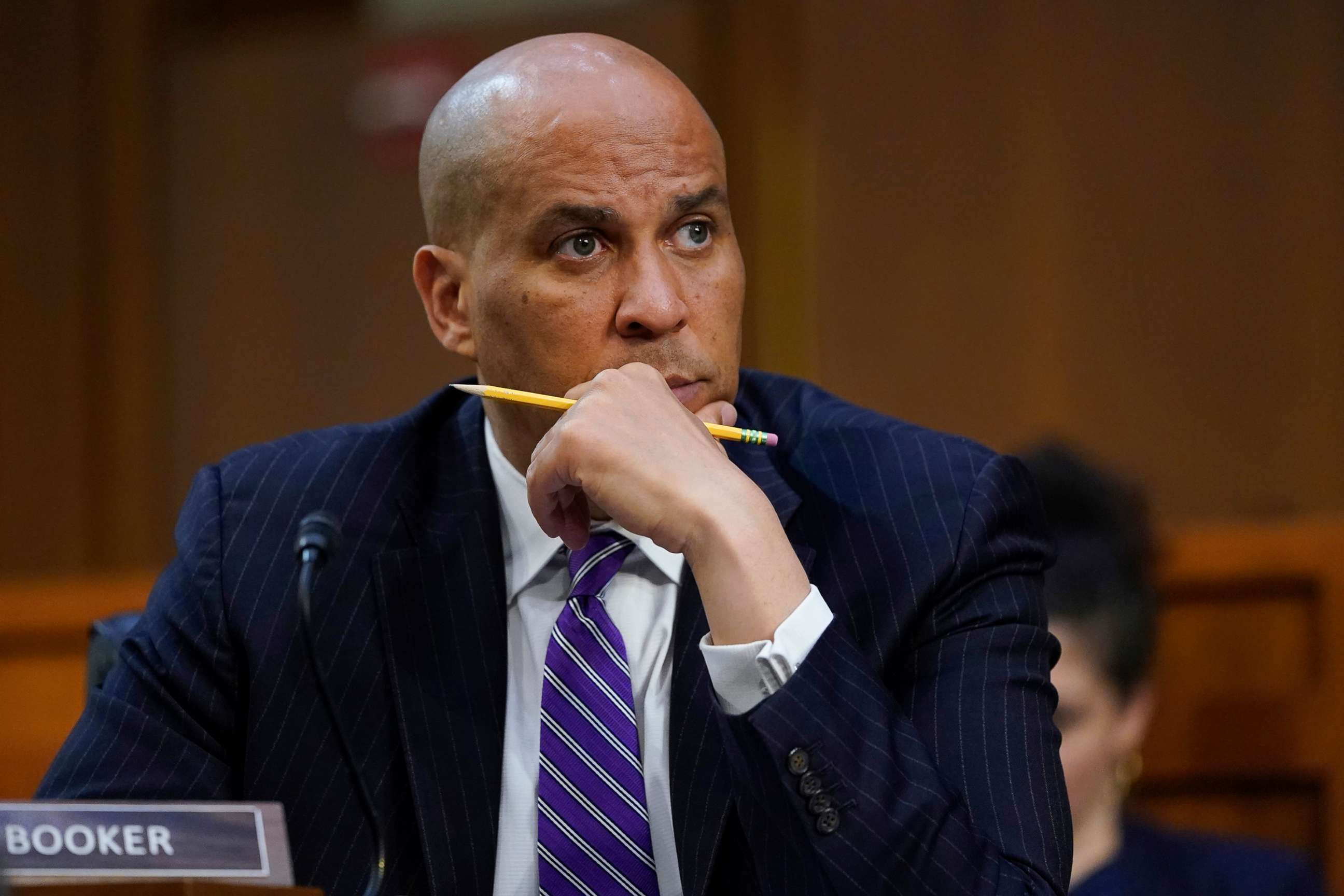
Sen. Cory Booker, D-N.J., defended Jackson after she was grilled by Republicans over sentencing, saying that "line of attack… doesn't hold water."
"I was a little insulted about the accusation that somehow, this mother of two, confirmed three times by the United States Senate, who has victim advocacy groups writing letters for … that somehow the implication that you are somehow out of the norm of other federal judges that we have confirmed …this implication that somehow your thoughtfulness on these very dense, fact-specific cases, is somehow out of norm, to me, does not hold up -- doesn't hold water," he said.
Sen. Cory Booker listens as Supreme Court nominee Ketanji Brown Jackson testifies during her Senate Judiciary Committee confirmation hearing on Capitol Hill in Washington, March 22, 2022.
Alex Brandon/AP
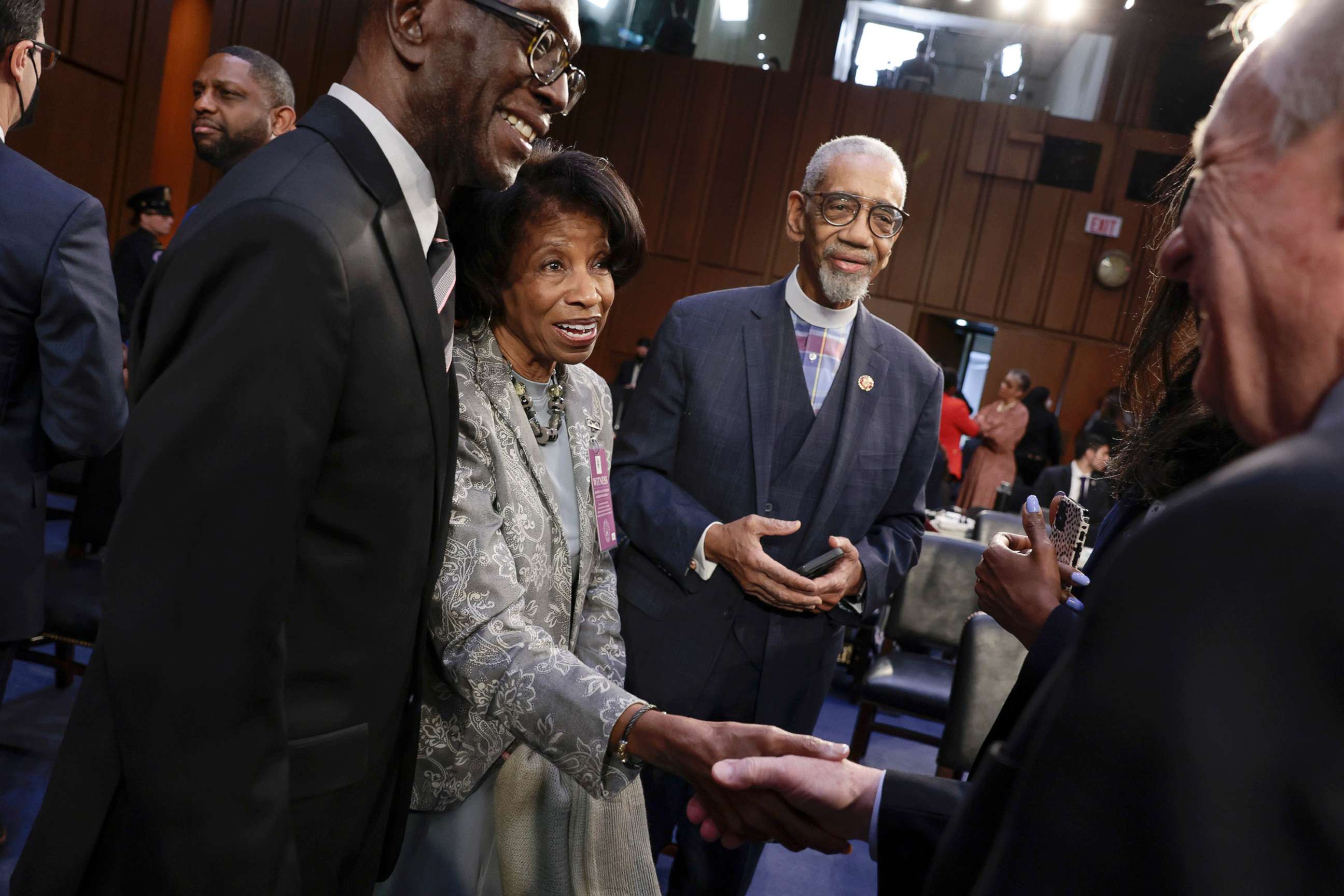
As Jackson's parents looked on, Booker said he wanted America to know more about Jackson's character and asked her to share about the values she's inherited from her parents.
Jackson got emotional as she spoke about her family, recounting how her parents were the first in their families to attend college. They "taught me hard work. They taught me perseverance. They taught me that anything is possible in this great country," she said.
Senate Judiciary Chairman Richard Durbin greets Ellery and Johnny Brown, the parents of U.S. Supreme Court nominee Judge Ketanji Brown Jackson in Washington, March 22, 2022.
Anna Moneymaker/Getty Images
She said her parents became "extraordinary public servants" because they wanted to give back to their community. And that they raised her in Washington, D.C., "on that hope and dream," "born here with an African name."
Booker also touched on Jackson's faith, asking her, "Where do you get the grit and guts to get back up and keep on going?"
Jackson responded by talking about her grandparents, who she said "didn't have it easy."
They "didn't have a lot of formal education," but "were the hardest working people I've ever known and got up every day and put one foot after the other and provided for their families and made sure their children went to college, even though they never had the opportunities," Jackson said.
"I stand on the shoulders of people from that generation," she said. "And I focus, at times, on my faith when I'm going through hard times. ... I think that's a common experience of Americans -- that when you go through difficult times you lean into family and you turn to faith."
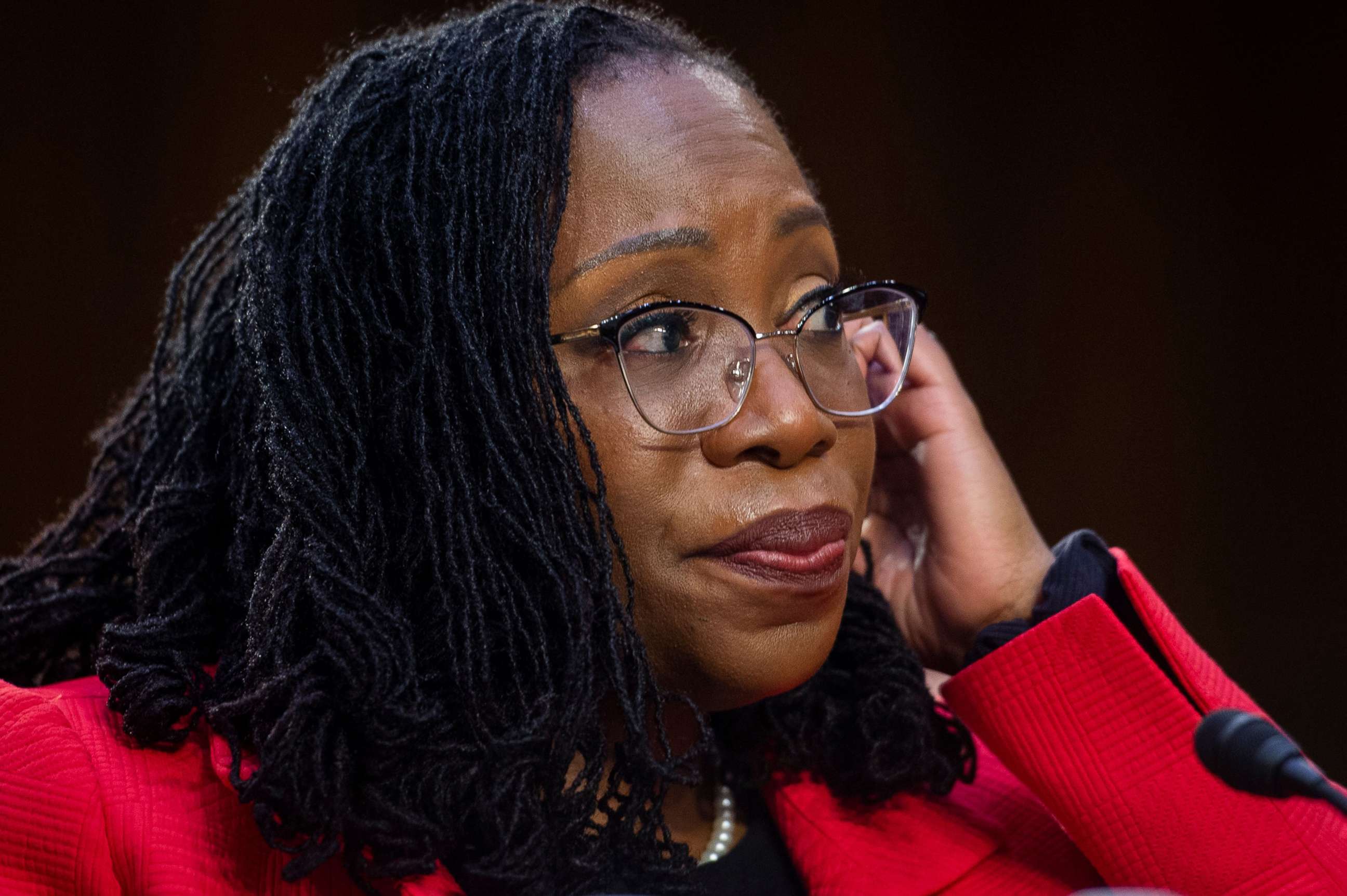
Judge Ketanji Brown Jackson appears for the second day of her Senate nomination hearings to be an Associate Justice of the Supreme Court of the United States, in the Hart Senate Office Building in Washington, March 22, 2022.
Shutterstock
Her voice shaking, she talked about the difficulties she's faced as a mom.
As a judge, she said, "There will be hearings during your daughters' recitals, emergencies on birthdays."
"I didn't always get the balance right," she said, adding that she hopes her daughters "can know that you don't have to be perfect in your career trajectory and you can still end up doing what you want to do."
Mar 22, 2022, 7:33 PM EDT
Cotton pushes Jackson on crime
Sen. Tom Cotton, R-Ark., who is considered a presidential hopeful, questioned Jackson on crime, continuing a GOP focus on crime and punishment that some see being more about political calculations than the nominee herself.
He first pushed her to answer if she believes the U.S. needs more or fewer police, calling it a "simple either/or question."
She responded, "Determination whether there should be more police is a policy decision by another branch of government. It is not something that judges have control over and I will stay in my lane in terms of the kinds of things that are properly in judiciary branch."
Cotton, appearing frustrated, said to the judge, "OK, you don't want to address it, we'll move on."
Sen. Tom Cotton listens as Supreme Court nominee Ketanji Brown Jackson testifies during her Senate Judiciary Committee confirmation hearing on Capitol Hill in Washington, D.C., March 22, 2022.
Alex Brandon/AP
Cotton asked more specific questions on crime, including if the average murder sentence -- which he said is 17 years -- is too long or too short.
Jackson responded, "Senator, these are policy questions ... They're not the kind of things I can opine about."
When Cotton asked her about rape sentences, Jackson responded, "Rape is not a crime in the federal system that I'm familiar with working with."
Cotton asked: "In 2020 alone well over 1 million -- 1 million -- violent crimes went unsolved in America. Do you think we imprison too many violent criminals or not enough?"
Jackson responded, "Senator, it's important for our rule of law to ensure that people are held accountable who are breaking the law in the ways that you mention and otherwise."
Cotton then asked her what she thought the families of the victims of unsolved crimes think.
The judge responded, "I know what the families of law enforcement officers think because I'm one of them. I know what crime does to our society. I care deeply about public safety, and as a judge, it's been my duty, when I was at the trial level … to ensure that people are held accountable for their crimes."
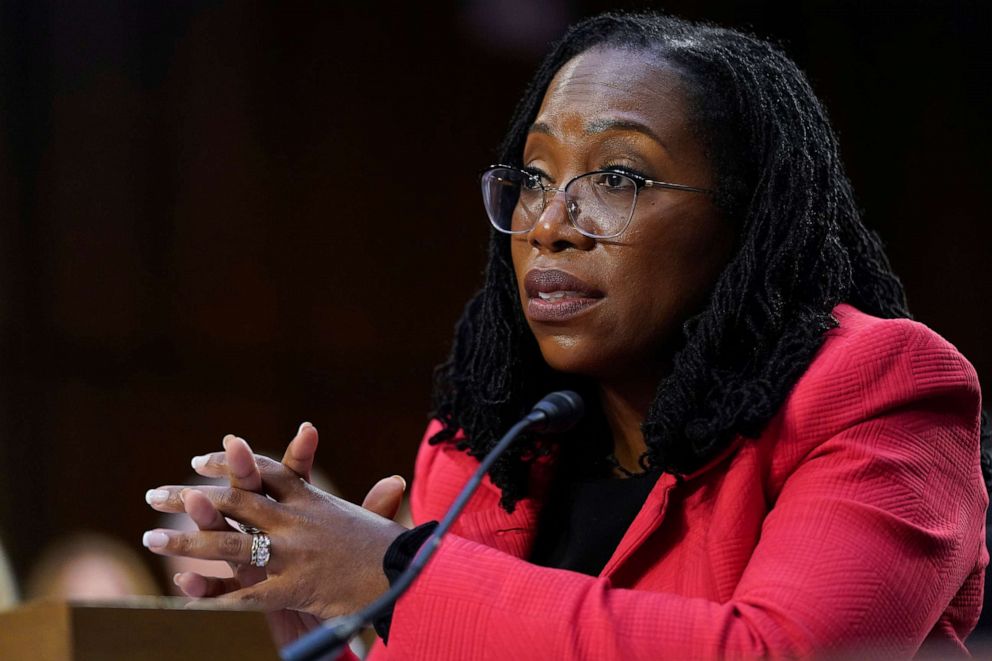
Supreme Court nominee Ketanji Brown Jackson testifies during her Senate Judiciary Committee confirmation hearing on Capitol Hill in Washington, D.C., on March 22, 2022.
Jackson, who has repeatedly pushed back on sentencing questions by referring to the role of Congress, did so again.
"That's not a simple question," she said. "The reason is because what this country does in terms of penalties is in Congress' province -- you all decide. You all decide what the penalties are. You decide what the factors are that judges use to sentence."
Cotton also asked about a specific drug case Jackson oversaw in which the defendant received a 20-year sentence and later applied for compassionate release. Cotton accused Jackson of rewriting the law and being sympathetic to a drug kingpin.
Jackson responded, "Respectfully, Senator, I disagree. Congress provided judges, through the compassion release motion mechanism, with the opportunity to review sentences. ... In [the defendant] Mr. Young's case, the question was, with this compassionate release motion, under a circumstance in which Congress had changed the law, was that an extraordinary and compelling circumstance to revisit his sentence? And I made a determination that it was."
"What I determined under those circumstances is that I would resentence Mr. Young to the penalty that Congress had decided was the appropriate penalty for the conduct that he committed as of the time of his motion," she said.