Russian forces are continuing their attempted push through Ukraine from multiple directions, while Ukrainians, led by President Volodymr Zelenskyy, are putting up "stiff resistance," according to U.S. officials.
The attack began Feb. 24 as Russian President Vladimir Putin announced a "special military operation."
Russians moving from Belarus towards Ukraine's capital, Kyiv, don't appear to have advanced closer towards the city since coming within about 20 miles, although smaller advanced groups have been fighting gun battles with Ukrainian forces inside the capital since at least Friday.
Russia has been met by sanctions from the U.S., Canada and countries throughout Europe, targeting Russia's economy and Putin himself.
Here's how the news is developing. All times Eastern.
Feb 15, 2022, 11:28 AM EST
Blinken talks with Russian counterpart
In a signal that the door to diplomacy could remain open, U.S. Secretary of State Antony Blinken and Russian Foreign Minister Sergey Lavrov spoke again Tuesday morning, according to a senior official with the U.S. Department of State.
The two had already spoken on Saturday and agreed to connect again in the coming days, the official said, as the two governments have delivered mixed messages on the extent of Russia's military presence and intent on Ukraine's border.
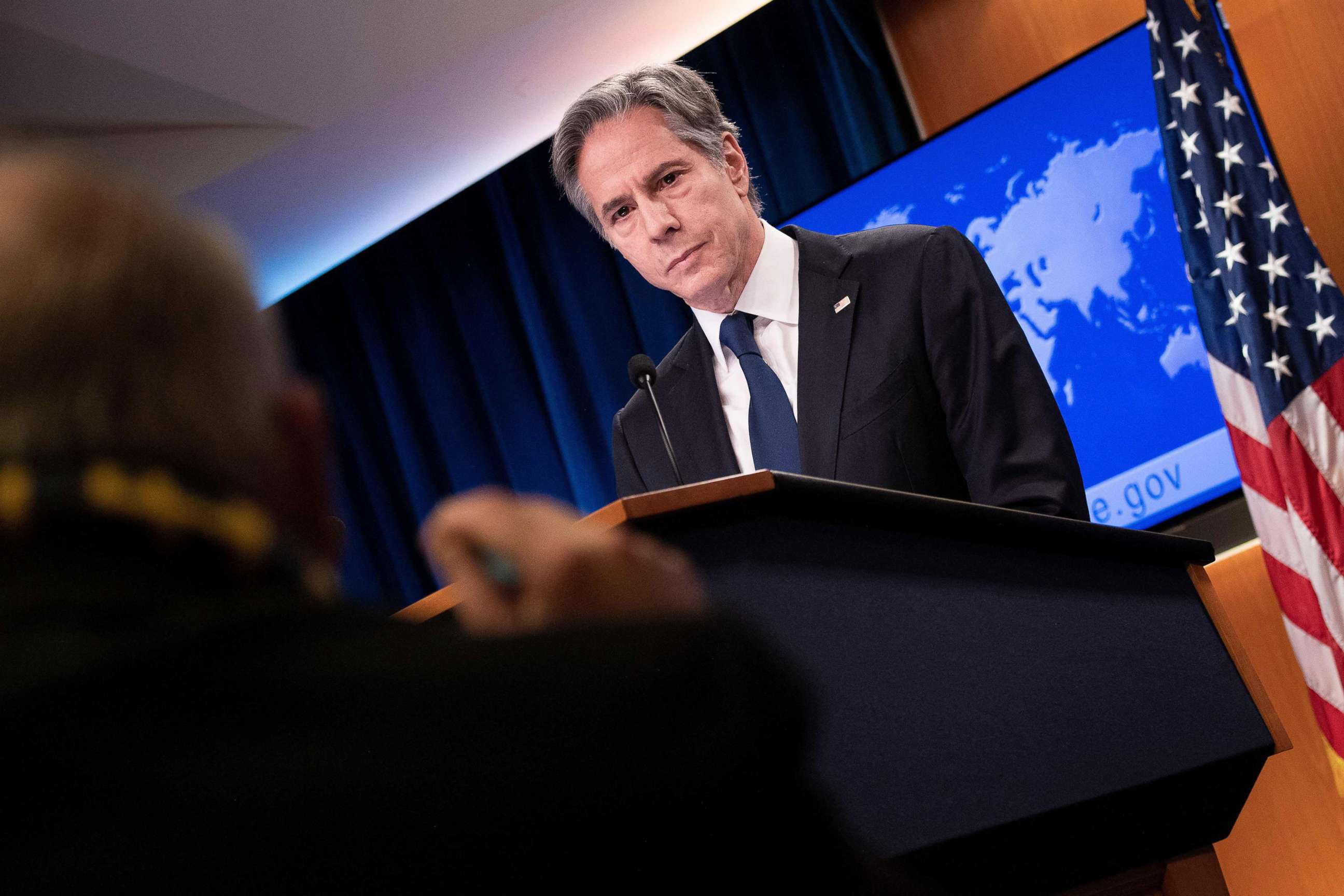
Secretary of State Antony Blinken speaks about Russia and Ukraine during a briefing at the State Department in Washington, D.C., Jan. 26, 2022.
POOL/AFP via Getty Images
Meanwhile, U.S. President Joe Biden had a phone call with French President Emmanuel Macron, according to a White House official, while U.S. Secretary of Defense Lloyd Austin has departed Washington, D.C., for Brussels for NATO meetings.
-ABC News' Conor Finnegan and Sarah Kolinovsky
Feb 15, 2022, 11:08 AM EST
Putin comments on 'partial withdrawal' of Russian troops
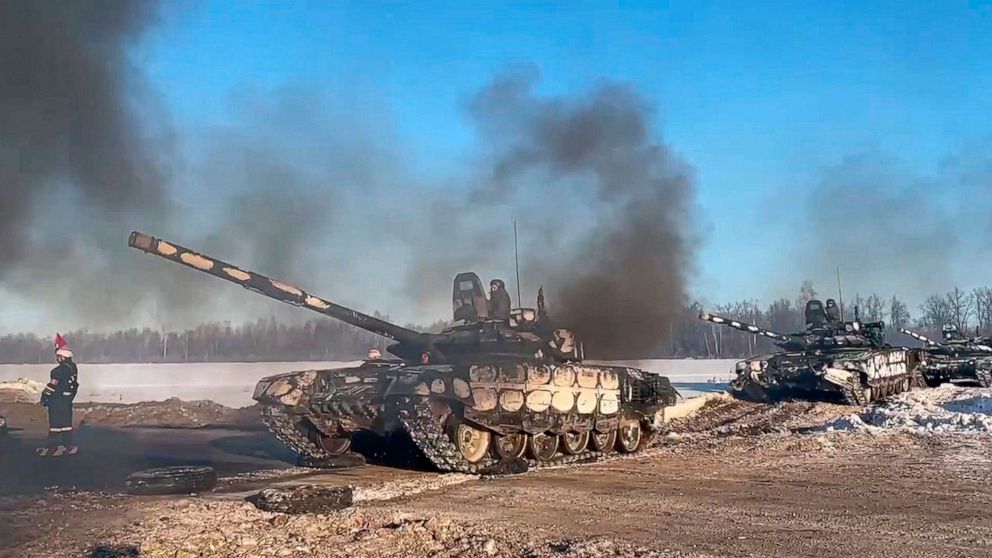
Russian President Vladimir Putin commented on what he called Russia's "partial withdrawal" of troops near Ukraine on Tuesday, one day after Pentagon officials said Russia had sent even more troops to the border region over the last 24 to 48 hours.
In this photo taken from video provided by the Russian Defense Ministry Press Service, Feb. 15, 2022, Russian army tanks move back to their permanent base after drills in Russia.
Russian Defense Ministry Press Service via AP
Putin delivered mixed messages at a press conference in Moscow, suggesting he does not consider the crisis to be resolved as Russia's key demand that Ukraine is barred from joining NATO has not been met. But he also said there were items in the U.S. responses "to discuss," specifically noting Russia is ready to talk about the Intermediate-range Nuclear Forces (INF) treaty, which the Trump administration withdrew from, among other "military confidence-building measures."
"We want to resolve this question right now. In the nearest future, in the course of the negotiating process, with peaceful means," Putin said.
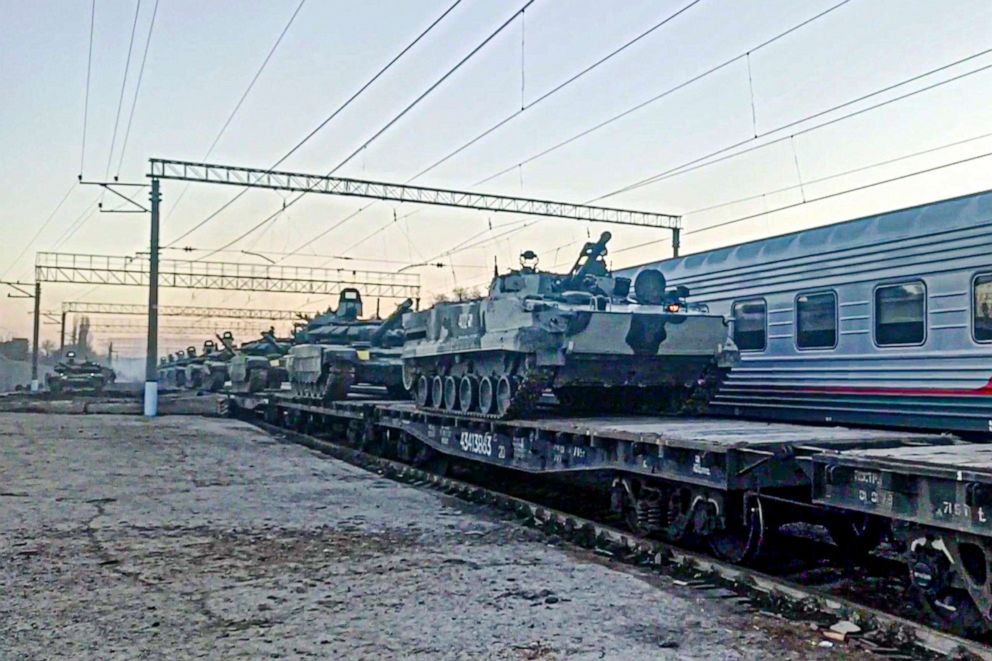
In this photo taken from video provided by the Russian Defense Ministry Press Service, Feb. 15, 2022, Russian armored vehicles are loaded onto railway platforms after the end of military drills in South Russia.
Russian Defense Ministry Press Service via AP
Asked about some Russian troops pulling back on Tuesday, Putin hinted there could still be room for escalation but added, "we will strive to agree on the issues which have been put forward by us using the diplomatic path."
"How will Russia act next? According to plan!" he said.
-ABC News' Patrick Reevell
Feb 15, 2022, 10:23 AM EST
Putin reacts to Russian parliament vote to recognize Donbas
Russian President Vladimir Putin indicated Tuesday that he will not immediately recognize two Russian-controlled breakaway regions in eastern Ukraine as independent.
Putin said he believes the idea has the support of the majority of Russians but that he thinks Russia should continue to try to resolve the conflict with Ukraine through the Minsk peace agreements.
The Minsk accords signed in 2014 and 2015 were aimed at ending the ongoing conflict between the Ukrainian army and the Russian-backed separatists forces in an area of southeastern Ukraine known as the Donbas. But Putin's recognition of the regions would amount to Russia formally withdrawing from the agreement.
Putin's comments suggest that while he doesn't intend to immediately move to recognize the regions, he might keep the action as a threat hanging over negotiations with Ukraine and the West. He painted the parliament vote as the expression of lawmakers rather than something directed by the Kremlin.
"We must do everything to resolve the problems in Donbas but, as before, starting from the possibilities from the Minsk agreement that have not been realized to their end," Putin said Tuesday.
Russian President Vladimir Putin speaks to German Chancellor Olaf Scholz during their talks in the Kremlin in Moscow on Feb. 15, 2022.
Mikhail Klimentyev/Sputnik/Kremlin pool photo via AP
Meanwhile, the leader of one of the regions welcomed the Russian parliament vote but fell short of calling on Putin to take the step.
"We thank the deputies of the State Duma for the results of today’s vote," Denis Pushilin, head of the self-proclaimed Donetsk People's Republic said in a statement Tuesday. "With that, we will treat with respect and understanding any decision taken by the top leadership of the Russian Federation."
Pushilin called the initiative "timely," given what he claimed was the threat from Ukraine, which he alleged was massing troops near the regions and showed Kyiv has no intention of fulfilling the Minsk agreements or resolving the conflict peacefully.
-ABC News' Patrick Reevell
Feb 15, 2022, 9:53 AM EST
US assessing Russia's claim of withdrawing some troops
The United States is assessing Russia's claim that it is withdrawing some troops from Ukraine's borders, U.S. Ambassador to NATO Julianne Smith said Tuesday.
During a press briefing at NATO headquarters in Brussels, Smith cast some doubt on the claim after Russia made similar statements in late December.
"All I can say is we'll have to verify that and take a look," Smith told reporters. "We want to make sure we understand what they're talking about when they say de-escalation, and we want to verify that that is in fact what's happening. So stand by, we'll obviously take a look at that."
When asked again whether some Russian forces were in fact pulling back, Smith reiterated: "I can't say yes or no. I can't say really anything about it at this moment because this is something that we'll have to look at closely and verify in the days ahead."
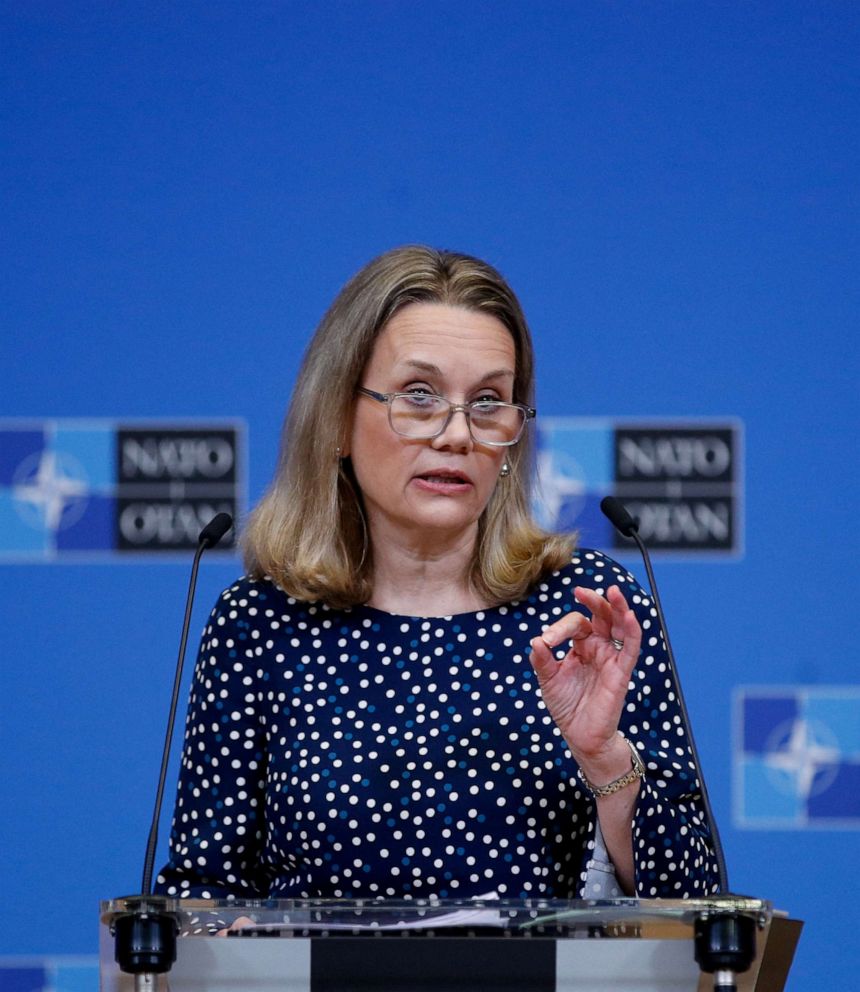
U.S. Ambassador to NATO Julianne Smith gestures during a press briefing ahead of a two-day meeting of the military alliance''s Ministers of Defense at the NATO headquarters in Brussels, Belgium, on Feb. 15, 2022. The upcoming meeting is expected to focus on tensions between Russia and the West over Ukraine.
Johanna Geron/Reuters
NATO's defense ministers, including U.S. Secretary of Defense Lloyd Austin, will meet Wednesday to discuss deployments within the military alliance and a "variety of contingencies," according to Smith, who noted that NATO "will continue to determine whether or not additional enhancements might be necessary."
While any Russian troop withdrawals could be a sign of de-escalation, the law passed Tuesday in Russia's parliament calling on President Vladimir Putin to recognize Russian-controlled breakaway regions in eastern Ukraine as independent would be a "new shift in the escalation," Smith said, adding that the U.S. and NATO "would monitor that very closely" and determine its response.
"If they proceed with this, then I think it's a clear violation of Ukraine's territorial integrity and its sovereignty, and it's also a violation of the Minsk agreement," she told reporters, "and so that would obviously be a new shift in the escalation."
As the U.S. and NATO await Russia's written proposals on issues like arms control and military exercises, Smith again called on Russia to engage meaningfully in talks.
"Look, we can spend the rest of the year going back and forth exchanging letters," she said, "but really what's important is the best way to proceed would be for us to sit down at the table again."
Until then, Smith said they do not know what Putin will decide.
"We do not understand fundamentally -- none of us do -- what is inside President Putin's head," she added, "and so we cannot make any guess about where all of this is headed."