Russian forces are continuing their attempted push through Ukraine from multiple directions, while Ukrainians, led by President Volodymr Zelenskyy, are putting up "stiff resistance," according to U.S. officials.
The attack began Feb. 24 as Russian President Vladimir Putin announced a "special military operation."
Russians moving from Belarus towards Ukraine's capital, Kyiv, don't appear to have advanced closer towards the city since coming within about 20 miles, although smaller advanced groups have been fighting gun battles with Ukrainian forces inside the capital since at least Friday.
Russia has been met by sanctions from the U.S., Canada and countries throughout Europe, targeting Russia's economy and Putin himself.
Here's how the news is developing. All times Eastern.
Feb 22, 2022, 8:28 AM EST
US embassy staff to stay in Lviv each day, in Poland at night
U.S. embassy staff who remained in Ukraine will be in the western city of Lviv during the daytime and stay in Poland each night for security reasons, amid fears of a Russian invasion, according to acting U.S. ambassador to Ukraine Kristina Kvien.
"We all heard the speech President Putin delivered yesterday," Kvien told reporters in Lviv on Tuesday. "His outrageous statements about Ukraine and the Ukrainian people were delusional, reflecting a warped vision reminiscent, not of a global leader, but of Europe's worst authoritarians."
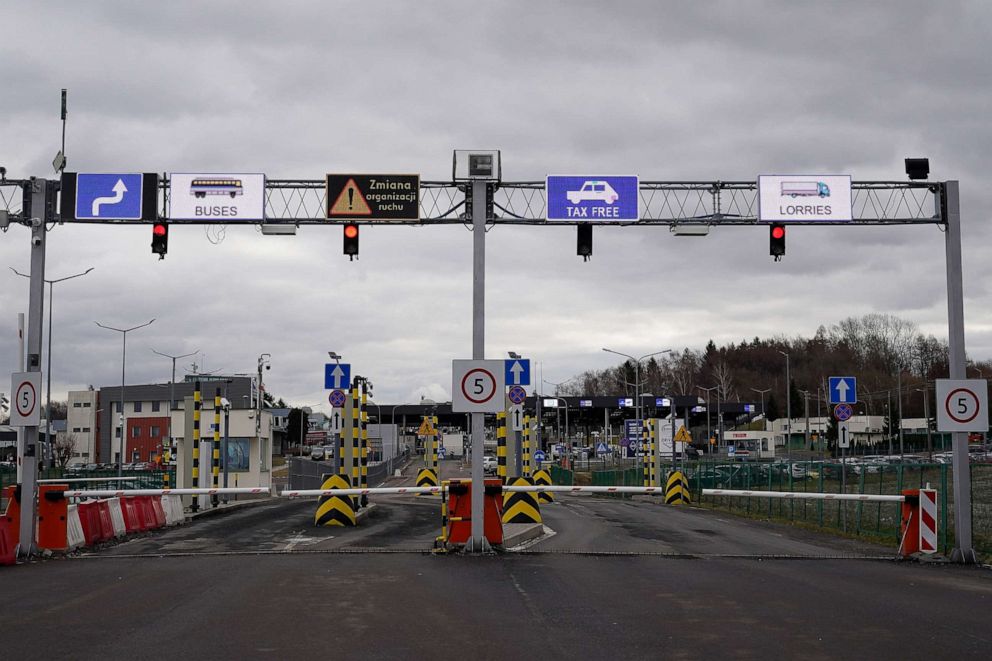
The normally crowded border crossing between Poland and Ukraine is seen nearly without traffic, in Medyka, Poland, Feb. 22, 2022.
Bryan Woolston/Reuters
The U.S. embassy's skeleton staff had relocated operations to Lviv from the Ukrainian capital, Kyiv. They returned to Lviv on Tuesday after staying in Poland overnight, a senior U.S. official told ABC News.
-ABC News' Martha Raddatz and Sam Sweeney
Feb 22, 2022, 7:40 AM EST
Germany halts key pipeline as part of sanctions against Russia
German Chancellor Olaf Scholz announced Tuesday that his country will halt its approval of the Nord Stream 2 natural gas pipeline connecting Germany to Russia, in response to Russia's recognition of two separatist areas in eastern Ukraine and amid fear of further possible aggression.
"The situation today is fundamentally different," Scholz said at a press conference in Berlin.
Scholz said he has asked Germany's Federal Ministry for Economic Affairs and Climate Action to take a step that blocks certification of the Nord Stream 2. That means the pipeline, which is already built, cannot go into operation for now.
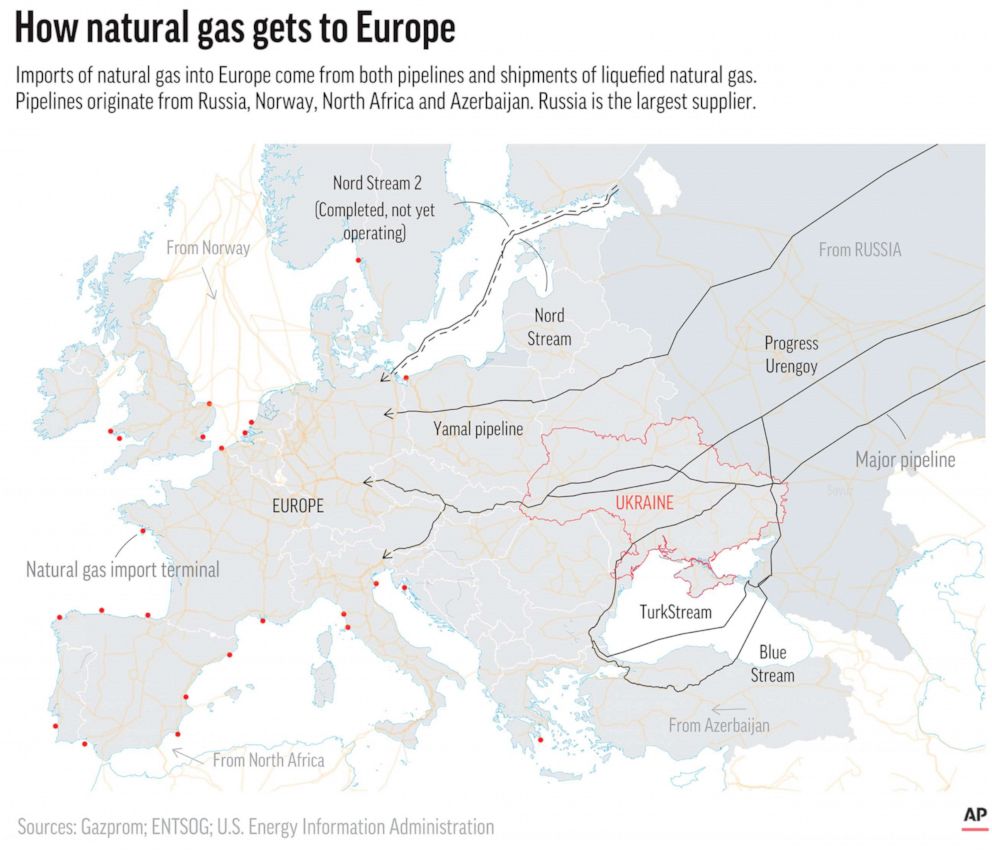
Map shows how natural gas is imported into Europe with both pipelines and ports.
AP
The Nord Stream 2, a key pipeline linking Russia to Europe by circumventing Ukraine, has been highly controversial, with Germany accused of allowing Russia to construct a geopolitical weapon enabling Moscow to pressure Europe using gas supplies. Last year, Ukraine and the United States were pushing to stop the project but Germany refused.
The decision to halt the pipeline's certification serves as a major sanction against Russia amid growing fears of an invasion of neighboring Ukraine and immense pressure on Germany to act. Earlier Tuesday, Ukrainian President Zelenskyy called on Germany to include the Nord Stream 2 in Europe's sanctions on Russia.
"At this stage, in addition to initial sanctions, it is now important to prevent further escalation and thus another catastrophe," Scholz said. "That is what all our diplomatic efforts are aimed at."
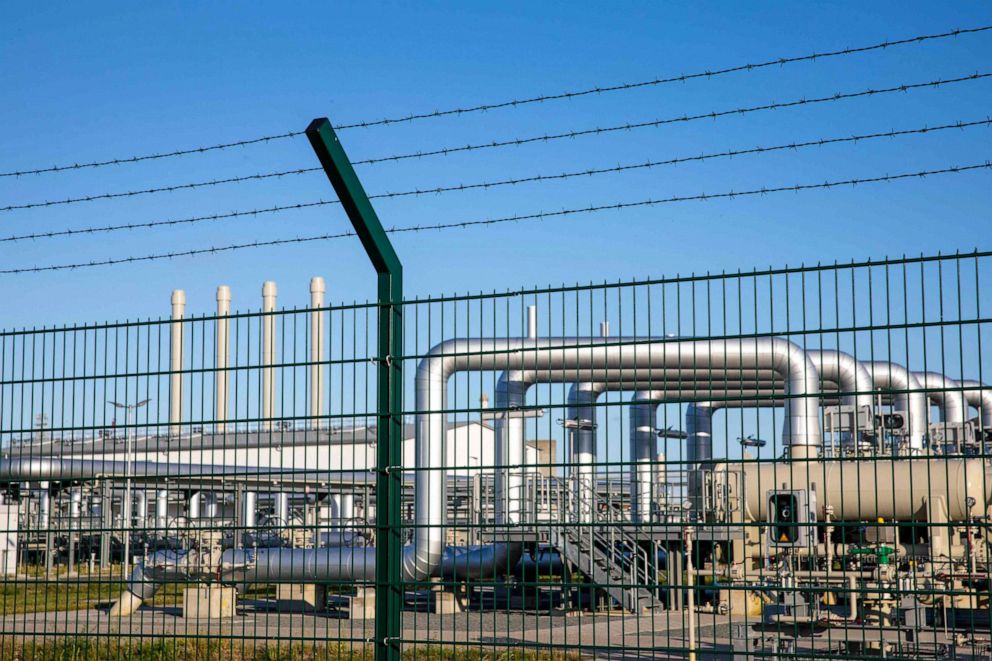
This photo taken on Sept. 7, 2020, shows the Nord Stream 2 gas pipeline landfall facility in Lubmin, northeastern Germany.
Odd Andersen/AFP via Getty Images, File
The move may amount to a huge blow to Russia, which has already stoked a gas crunch in Europe by having its state-owned energy company Gazprom deliver the bare minimum of gas despite severe shortages. Gazprom has continued to do that in recent weeks and could go further, and Germany is particularly vulnerable. During a press conference last week, Scholz repeatedly refused to explicitly say if he would be willing to halt the Nord Stream 2.
However, by suspending the pipeline's certification, Germany dangles the possibility it could be resumed if Russia doesn't make further aggressions against Ukraine. It's unclear how Russia will respond to a continent that it knows is overly reliant on Russian energy.
-ABC News' Mary Bruce, Sarah Hucal, Ian Pannell and Patrick Reevell
Feb 22, 2022, 7:12 AM EST
Ukraine doesn't believe Russia will mount 'large-scale' invasion
Ukrainian President Volodymyr Zelenskyy said Tuesday he won't introduce martial law for now because his government doesn't believe that Russia will mount a "large-scale" invasion.
"We believe that there won't be a war, a powerful one, against Ukraine and there won't be a large-scale escalation from Russia," Zelenskyy said during a joint press conference in Kyiv with his Estonian counterpart. "If there will be, we will impose martial law."
Zelenskyy also revealed that he's considering breaking off diplomatic relations with Russia over its recognition of two Russia-backed separatist areas in eastern Ukraine's Donbas region. He said a proposal to do so has been put forward by the Ukrainian Ministry of Foreign Affairs, which he said he's looking at it but has not yet made a decision.
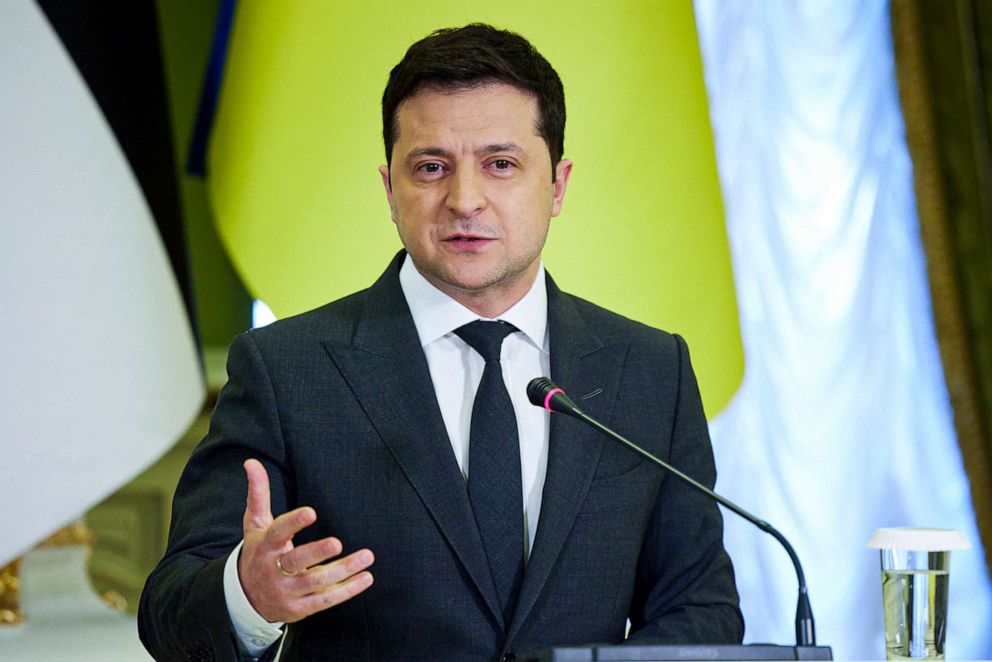
In this handout photo provided by the Ukrainian Presidential Press Office, Ukrainian President Volodymyr Zelenskyy gestures during a joint news conference with Estonian President Alar Karis following their talks in Kyiv, Ukraine, Feb. 22, 2022.
Ukrainian Presidential Press Office/Handout via AP
The Ukrainian president also called for Western countries to impose sanctions fast against Russia, saying the situation is developing "very quickly" and that the "first steps" of Moscow's aggression have already been made. Zelenskyy said sanctions should include fully stopping the Nord Stream 2 gas pipeline connecting Russia to Germany.
"The reaction must as quick," he noted. "Sanctions policy is more a powerful policy which can really have an effect on the probable escalation from Russia. Don't wait for it to happen, because already the first steps of this aggression are done. We believe that legally the aggression has already been done."
-ABC News' Patrick Reevell
Feb 22, 2022, 7:01 AM EST
Kremlin calls Western reaction 'predictable'
Kremlin spokesman Dmitry Peskov said Tuesday that the reaction of Western countries to Russia's recognition of two Russia-backed separatist areas in eastern Ukraine is "predictable."
"As for the reaction, it was predictable, foreseeable," Peskov told reporters during a daily call. "We will continue to work and to patiently put across our arguments."
Peskov also claimed not to know anything about possible deployments of Russian "peacekeepers" into the areas overnight and made a comment that suggested the Kremlin may consider the legitimate territory of the separatists to include large parts of eastern Ukraine currently not in their control.
Separatists in the self-declared People's Republics of Donetsk and Luhansk only hold about a third of the territory they claim in eastern Ukraine's Donbas region. The fear is Russia might now back those claims and use it as a pretext to make a larger land grab and destroy Ukrainian forces.
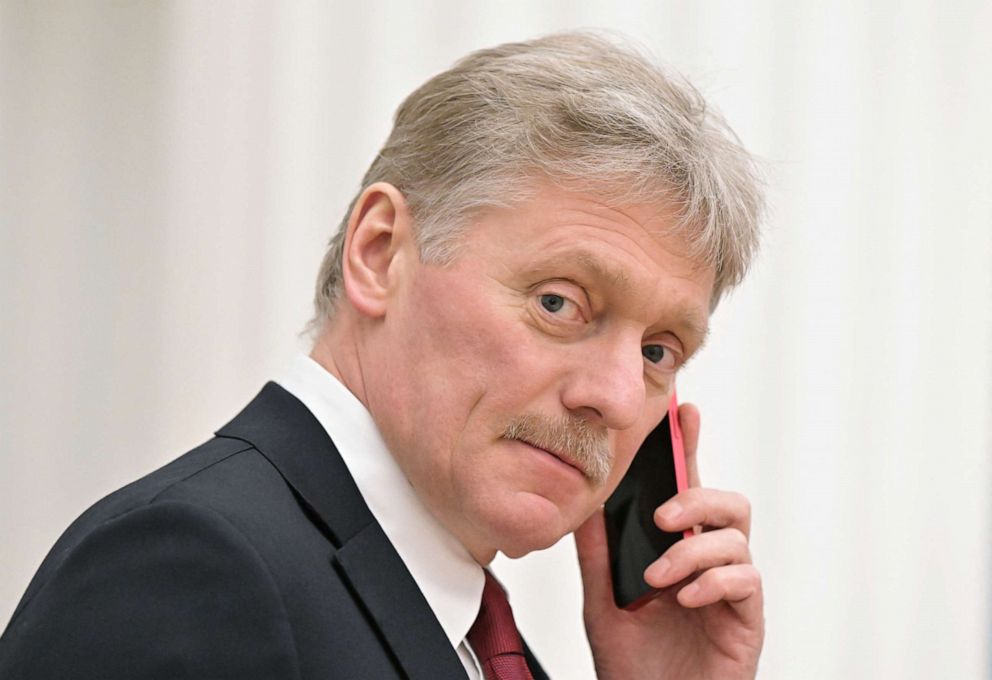
Kremlin spokesman Dmitry Peskov attends a joint news conference of Russian President Vladimir Putin and Belarusian President Alexander Lukashenko in Moscow, Russia, Feb. 18, 2022.
Sputnik/Sergey Guneev/Kremlin via Reuters
Speaking to reporters Tuesday, Peskov said the Kremlin recognizes the separatist areas "in those borders which they have declared for themselves, when these two republics were declared."
But when asked to clarify, Peskov added: "In those borders, in which they exist and were declared. And were declared and exist."
When pressed if that meant within the "present borders" of the separatist areas, Peskov refused to answer, saying he had nothing more to add.
Peskov also said that Russia's recognition of the areas means the issue of the Minsk agreement is "now off the agenda." He said any negotiations going forward will focus only on Russia's demands for security guarantees that Ukraine not join NATO.
Peskov noted that the United States has not contacted the Kremlin since Russian President Vladimir Putin announced Monday his recognition of the two separatist areas as independent, but that Moscow was "open to diplomatic contacts."
What happens next, he said, is "up to our opponents."