Pence, Harris face off in VP debate with diverging views of America

Highlights from the first and only matchup between Biden, Trump's running mates

Last Updated: October 15, 2020, 9:27 AM EDT

With plexiglass and more than 12 feet of distance separating them, Vice President Mike Pence and Democratic nominee Sen. Kamala Harris of California debated in Salt Lake City in the first and only one-on-one matchup between the vice presidential candidates.

The showdown came as President Donald Trump and several in his orbit have tested positive for the novel coronavirus, raising questions on a transfer of power to the vice president were Trump at 74 -- or Democratic nominee Joe Biden at 77 -- to become too ill to serve.

The debate's format was divided into nine 10-minute sections with each candidate having two minutes to respond to the opening question in each segment and the remaining time allowed for follow ups. Moderator Susan Page, Washington Bureau chief of USA Today, did not release the topics in advance.

The sole vice presidential debate follows Trump and Biden's chaotic debate last week in Cleveland.

Oct 07, 2020, 3:46 PM EDT

Pence vs. Harris on the issues: COVID-19

In February, Trump announced that Pence would lead the federal government's response to the COVID-19 pandemic, the biggest crisis he's ever managed in his political career. Pence held numerous White House Coronavirus Task Force briefings at the height of the pandemic and oversaw the deployment of personal protective equipment and ventilators to states facing an overwhelming number of patients.

Pence repeatedly downplayed the severity of the virus, both with his actions and public statements. He once said that the pandemic would largely be behind the nation by Memorial Day and in April, Pence disregarded a Mayo Clinic policy and did not wear a mask while visiting patients in Minnesota, even after his office was informed about the policy there.

Since that visit, Pence and his staff have been more consistent in wearing a mask in public, but he has occasionally walked a rope line after campaign events without one, signing autographs, but staying a few feet back.

Harris has continuously condemned Trump's handling of the COVID-19 pandemic and repeatedly called for leaders to "listen to the scientists and the experts," on how to proceed. In August, when she and Biden sat down with ABC's "World News Tonight" anchor David Muir and "Good Morning America" co-anchor Robin Roberts, Harris said their approach will be guided by public health experts "unlike what we have seen now which are the politics guiding a public health crisis."

In their first joint interview after the Democratic National Convention, the two spoke exclusively to the "World News Tonight" anchor and "Good Morning America" co-anchor Robin Roberts.
13:30
Joe Biden, Kamala Harris talk COVID-19 and taxes with ABC's David Muir: Part 1In their first joint interview after the Democratic National Convention, the two spoke exclusively to the "World News Tonight" anchor and "Good Morning America" co-anchor Robin Roberts.
ABCNews.com

Harris has called for what she describes as a national "standard" for wearing masks. And on a possible vaccine for the coronavirus, Harris said she wouldn't solely believe Trump on its efficacy. She said she'd want to hear information from credible sources before believing it's safe. "I will not take his word for it," Harris said on CNN. "He wants us to ingest bleach."

-ABC News' Justin Gomez and Averi Harper
Oct 07, 2020, 3:09 PM EDT

Harris, Pence both skilled in debate format

Both vice presidential nominees are seasoned debaters. During her ill-fated presidential primary bid, Harris participated in several debates and made headlines for her zingers, including a clash with Biden over busing to integrate schools. Expectations are high for her in the matchup against Pence, who hasn’t participated in a debate since 2016 but has held his own ground in the past.

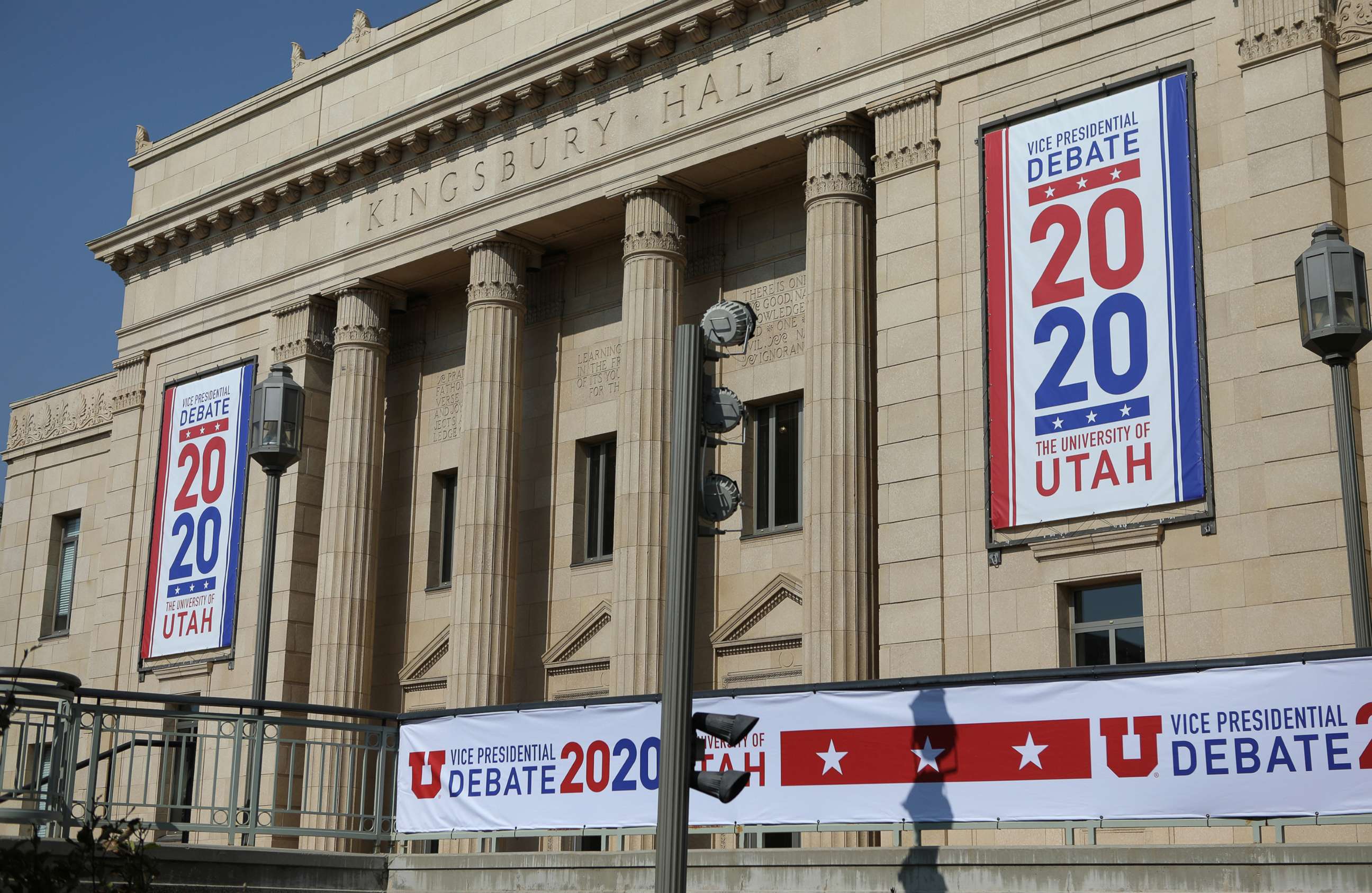
PHOTO: Banners hang on Kingsbury Hall, a day ahead of the vice presidential debate between Vice President Mike Pence and Senator Kamala Harris, on the campus of the University of Utah in Salt Lake City, Oct. 6, 2020.
Banners hang on Kingsbury Hall, a day ahead of the vice presidential debate between Republican vice presidential nominee and Vice President Mike Pence and Democratic vice presidential nominee and Senator Kamala Harris, on the campus of the University of Utah in Salt Lake City, Oct. 6, 2020.
Jim Urquhart/Reuters

In an interview with Hillary Clinton for her podcast “You and me Both,” Harris spoke about the challenges of preparing the debate, including her expectation that Pence could offer “a series of untruths” from the debate stage.

“I don't necessarily want to be the fact checker,” Harris said in the interview. “At the same time, you know, depending on how far he goes with whatever he does, he’s going to have to be accountable for what he says.”

Pence has called Harris a “skilled debater” and has told supporters at campaign events that he looks forward to being on stage with her, though he has remained mostly tight lipped about his expectations or how he’s been preparing for the matchup.

In 2016, Pence participated in the vice presidential debate against Sen. Tim Kaine and was seen to have successfully thwarted attacks over comments Trump made about women and Mexican immigrants, as well as his policy proposals.

During his debate against Kaine, Pence was disciplined, poised and polished and largely waited for his turn to get a response in.

-ABC News' Justin Gomez and Averi Harper
Oct 07, 2020, 2:17 PM EDT

Experts express concerns about possible coronavirus transmission at vice president debate

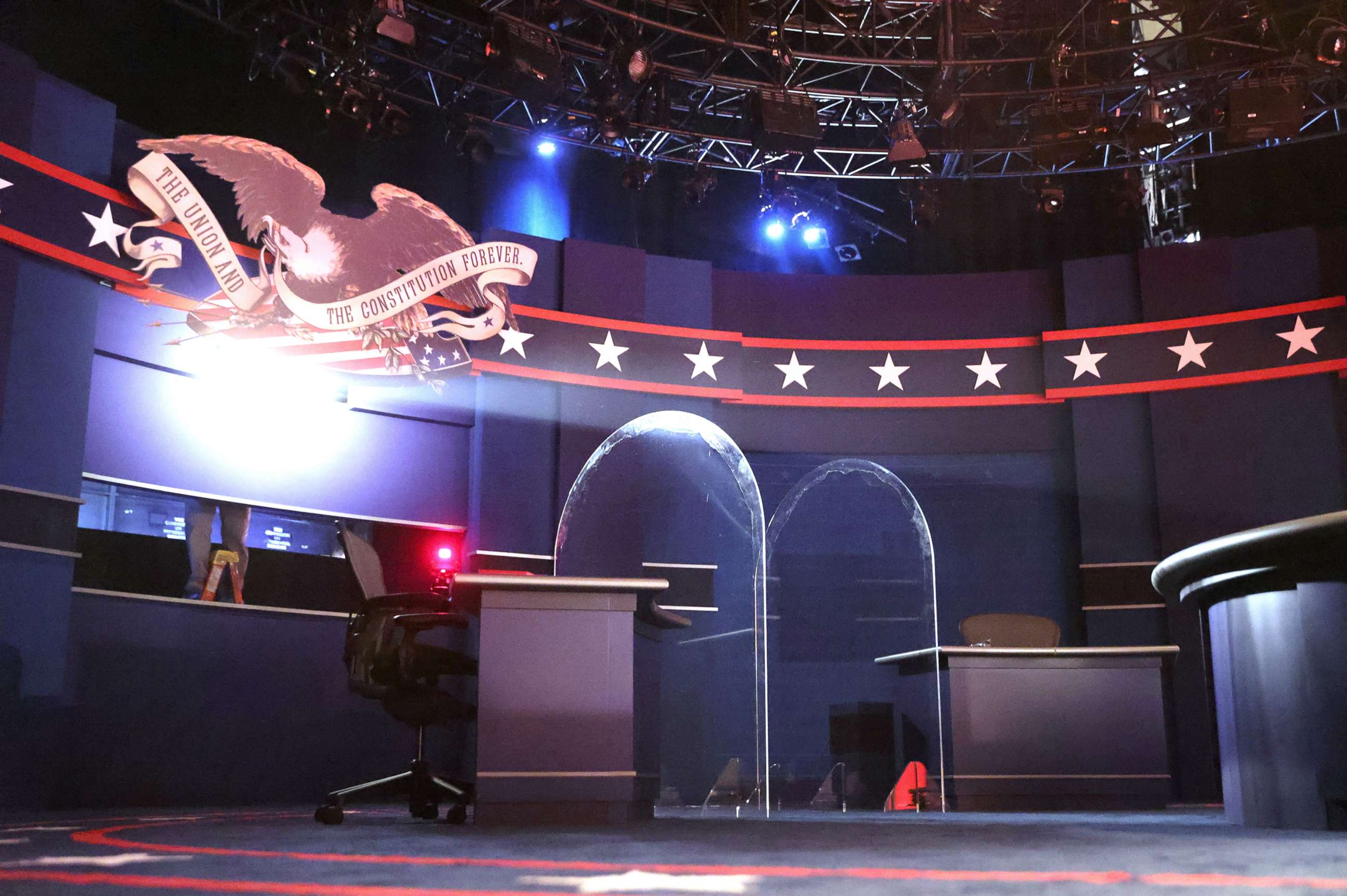
Two, five-foot tall plexiglass walls will stand between Vice President Mike Pence and Sen. Kamala Harris at Wednesday night’s debate.

The thick plastic barriers, approved by the Commission on Presidential Debates, will try to prevent the possible transmission of the coronavirus as Pence and Harris face off onstage for 90 minutes.

The Debate Commission said the plexiglass was part of a “variety of health safety protocols,” according to a factsheet. “Plexiglass will be used as part of the CPD’s overall approach to health and safety.”

Newly installed plexiglass barriers are shown on the stage ahead of the vice presidential debate in Kingsbury Hall at the University of Utah, Oct. 6, 2020, in Salt Lake City, Utah.
Justin Sullivan/Getty Images

Experts say that among the many protective measures put in place, the proposed plexiglass may not be the most effective option, particularly in light of updates from the Centers for Disease Control and Prevention to its guidelines on Monday acknowledging the potential for airborne transmission of the virus while indoors.

According to the CDC, it's possible for the virus to be transmitted beyond 6 feet by forming particles that can linger in the air for prolonged periods of time when infectious individuals “cough, sneeze, sing, talk, or breathe." The risk of airborne transmission is greatest in poorly ventilated indoor spaces as well as during prolonged exposure. Pence and Harris will be 12 feet apart from each other and from the moderator.

The clear dividers on stage could offer an added layer of protection, but it should not be a standalone measure, experts say.

More on experts concerns about safety protocols for the debate can be found here.

-ABC News' Sasha Pezenik and Ramie Fathy

Oct 07, 2020, 2:09 PM EDT

Social distancing, plexiglass have been utilized in Senate debates over the past few weeks

Amid the controversy surrounding a plexiglass barrier at the vice presidential debate Wednesday, a number of Senate debates across the country have utilized the measures.

In last Friday's South Carolina debate, Democratic challenger Jaime Harrison brought his own plexiglass divider to his debate against Sen. Lindsey Graham.

Both candidates said they tested negative the day before the debate and those attending had to fill out a questionnaire saying they had no symptoms.

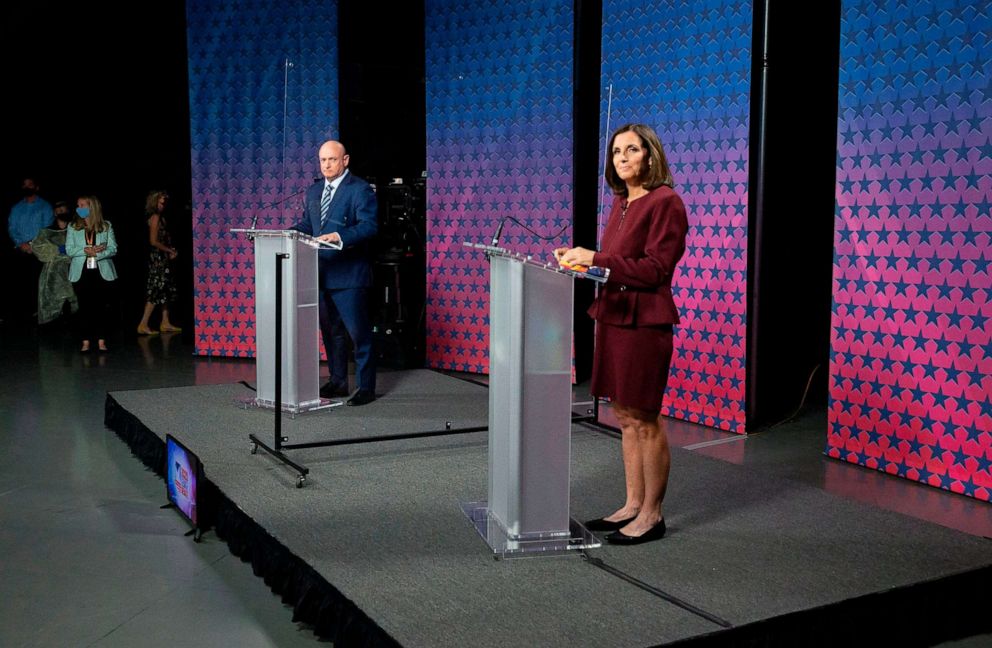
The Arizona Senate debate on Tuesday night also saw the candidates using plexiglass dividers.

Sen. Martha McSally and Democratic challenger Mark Kelly are separated by plexiglass as they participate in a debate at the Walter Cronkite School of Journalism at Arizona State University in Phoenix, Oct. 6, 2020.
Rob Schumacher/Pool/AFP via Getty Images

In Colorado, Sen. Cory Gardner and Democratic challenger John Hickenlooper were separated with plexiglass dividers. Both candidates tested negative prior to the debate.

In North Carolina's debate last Thursday, plexiglass wasn't used, but Sen. Thom Tillis and challenger Cal Cunningham were socially distanced from each other and the moderator.

In Iowa, Theresa Greenfield and Sen. Joni Ernst shared a table with the moderators. All were separated by plexiglass barriers.

-ABC News' Meg Cunningham and Kendall Karson

Sponsored Content by Taboola