Trump defends spending millions on taxpayer-funded promotional ads: 'For the country'
The White House defends the spots as educational public service announcements.
The Trump administration is facing growing questions for spending millions of taxpayer dollars to air unusual TV ads promoting Trump and his administration in the weeks ahead of the midterm elections.
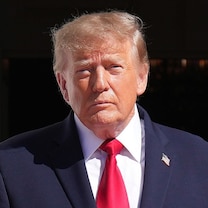
On Wednesday, President Donald Trump defended the ads, saying they are "for the spirit of our country" and not a political endorsement for Republican candidates on the ballot this November or for his administration's policies.
"You have to understand; I'm not promoting a candidate. I'm not promoting myself because I'm not running for office. I'm promoting the country," Trump said to reporters during an event in the Oval Office.
"Now, if somebody said that that's wrong, I'll gladly pay the money. But these are ads for the country," he said.
Trump has implored Republican voters to "pretend" that he is on the ballot in the November midterm elections to boost voter turnout for GOP congressional candidates.
At a separate event Wednesday, Trump again argued that his involvement on the campaign trail is crucial for party success.
"I hope you can believe that I'm running. They like to say, 'Oh, nobody wants him.' Well, everybody that has me wins," Trump said.
The federal government has spent at least $2.5 million to air three different television ads, according to an estimate from AdImpact, an advertising agency that analyzes ad spending across television.
A total of $20 million from the Department of Homeland Security's budget has been allocated for the effort.
Ethics watchdogs and several Congressional Democrats -- as well as some Republicans -- have said the ads are inappropriate. Some critics have said the ads could violate federal propaganda law.

“It’s a great message, I like the message, but it shouldn’t be paid for by taxpayer dollars,” Senate Majority Leader John Thune, R-S.D., said Monday.
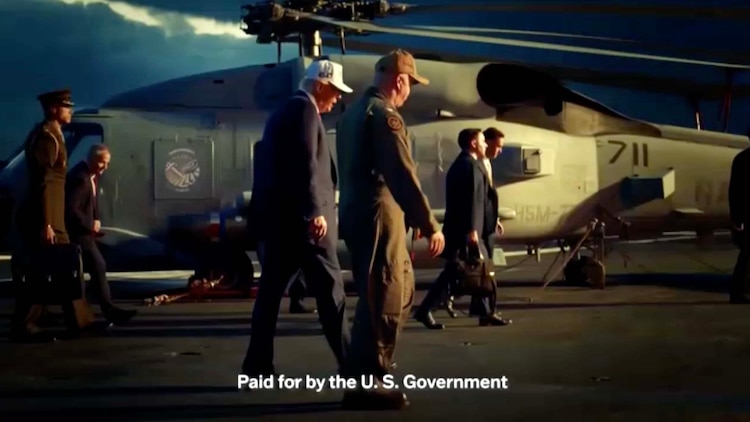
Four ads have been aired since last week. One of the ads features Trump in monochrome, slowly walking down a hallway, describing “the final battle” against "the deep state,” “the globalists,” and “the sick political class that hates our country.”
Another ad includes a montage of clips and images of Trump at events and rallies featuring onscreen text about the "largest tax cuts in history."
The latest ad, released Wednesday, focuses on the U.S. war with Iran, now in its eighth month. Audio of Trump and Defense Secretary Pete Hegseth plays in the background as U.S. military footage, including unclassified strikes, is displayed.

The video in the ad appears to be the same as one played during the Republican midterm convention last month. And it played Wednesday before Hegseth addressed 600 service members in his State of the Force speech at the Marine Corps base at Quantico, Virginia.
The ads all say "Paid for by the U.S. Government" across the bottom of the screen as they end.
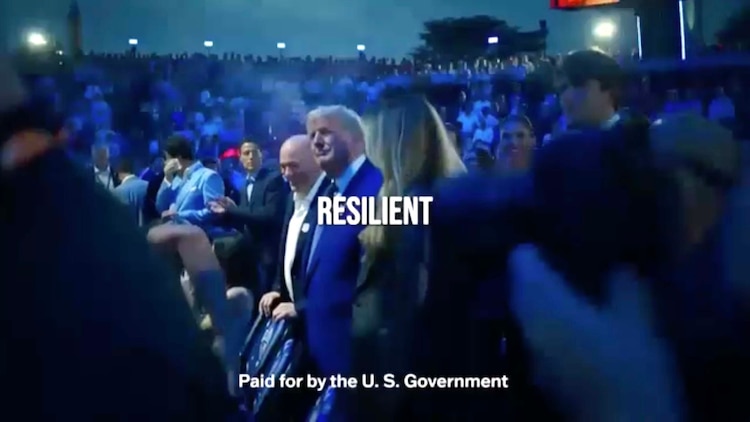
The White House has defended these spots as educational public service announcements (PSAs) and has said the ads are “very clearly not campaign ads” and instead “a reminder for Americans to love their country and know why it’s worth defending.”
On Tuesday, Democratic Sens. Patty Murray and Chris Murphy sent a letter to Homeland Security Secretary Markwayne Mullin accusing the department of “a shockingly corrupt misuse of taxpayer dollars.”
In the House, Democratic Reps. Jamie Raskin and George Whitesides have asked federal watchdogs to investigate the ads.
Raskin, the top Democrat on the House Judiciary Committee, and Whitesides wrote to the Government Accountability Office and U.S. Office of Special Counsel on Wednesday, describing the commercials as “desperate pre-election propaganda."
Federal Communications Commission Chair Brendan Carr said Wednesday that the ads paid for with government funds don’t “merit any sort of FCC review.”
“It doesn’t strike me as anything at all out of the ordinary,” Carr said of the ads, during a press conference with reporters.
Asked about allegations that the ads are “propaganda,” Carr laughed.
The White House has “explained that these are just normal-course public service announcements, PSAs, that you see all the time. I don’t think there’s anything unique or different about it,” he said.
“There’s nothing in there that strikes me that merit any sort of FCC review,” he added.
Related Topics

Popular Reads
ABC News Live