Trump again stokes racial divides, a reality at odds with his efforts to court black voters
The president threatened protesters with "vicious dogs" and "ominous weapons."
President Donald Trump’s controversial comments suggesting looters in Minneapolis be shot and calling protesters “thugs” marks the latest example of the president choosing to stoke long standing racial divides rather than trying to comfort a hurting community, a reality at odds with his campaign’s effort to court black voters.
As the death of George Floyd sparked widespread condemnation after disturbing video spread across social media showing a police officer with his knee on Floyd’s neck as he yelled out, "I can't breathe,” the president remained silent for days on the topic.
Trump instead tweeted repeatedly about topics in the news and pushed unfounded claims about mail-in ballots being tied to widespread fraud and continuously promoted a baseless murder conspiracy, despite a widower’s plea, to smear a cable news host.
The president first commented on Floyd's death Wednesday afternoon after being asked by a reporter while touring Kennedy Space Center. He would go on to announced he'd asked the F.B.I. and Justice Department to investigate the incident.
But at nearly 1 a.m on Friday, as protests were raging around the country in the wake of another in-custody death of a black man, the president seemingly reverted to a place critics say he often heads; stoking heated tensions and fanning the flames of longstanding racial division.
In late-night tweets, which Twitter flagged for “glorifying violence,” the president smeared protesters as “thugs,” threatened to use military force to “assume control,” and said “when the looting starts, the shooting starts,” echoing a phrase first used by a Miami police chief that civil rights groups have widely condemned.
Trump and the White House have since tried to walk back the comments, claiming the president was not encouraging violence and that the president meant “looting leads to shooting,” saying he didn’t know the phrase's origins.
The president’s campaign in a statement blamed the media, Twitter, and Democrats for “twisting of President Trump’s words… to take the entire nation down the worst road imaginable.”
“The facts show that the President expressed horror over the killing of George Floyd in Minneapolis and ordered the Department of Justice to get involved. When riots erupted in that city and elsewhere, he warned on Twitter that looting could quickly turn into violence,” Trump campaign manager Brad Parscale said in a statement.
But, senior Trump campaign advisor Katrina Pierson defended the president’s words on Twitter writing, “There’s no problem standing up to the looters and vandals,” in response to Massachusetts Sen. Elizabeth Warren criticizing Trump for suggesting looters should be shot.
Trump’s remarks were swiftly condemned by activists and critics claiming Trump’s words suggesting looters should be shot showed a stark difference between how the president responds to civil unrest depending on who’s protesting, pointing to Trump’s tweets from a few weeks back egging on mostly white and some armed conservative groups protesting lockdown measures amid the coronavirus in contrast to his remarks on majority black protesters in Minnesota.
“You’re quick to send your troops to kill us?” Leslie Redmond, the head of Minneapolis NAACP said at a press conference on Friday. “You were crying, ‘liberate Minnesota,’ when it came to economics, property, and money. When are you going to tell them to liberate black people in America?”
But following a night of civil unrest across the country, the president Saturday morning again threatened violent retaliation against protesters.
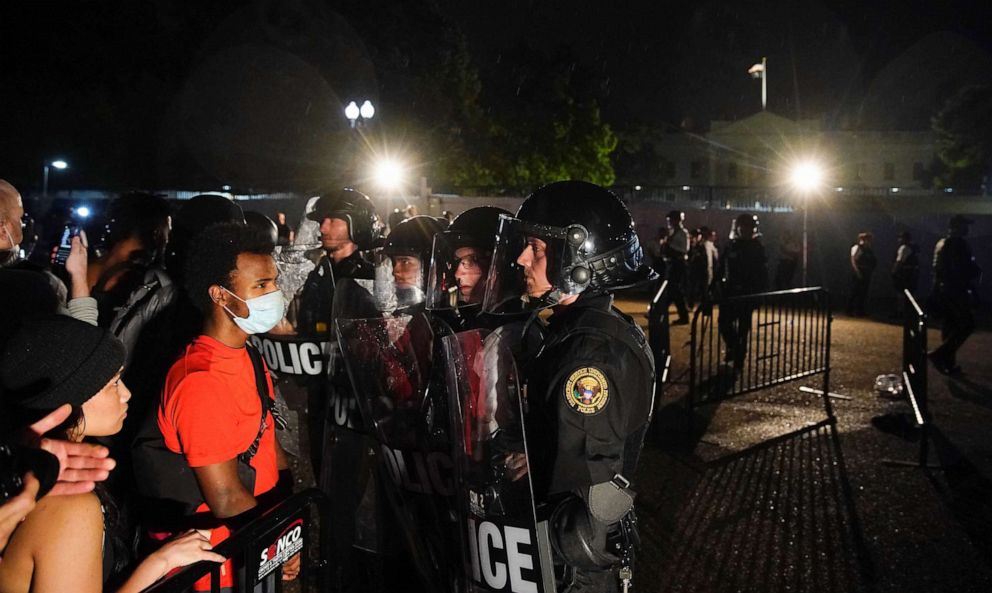
Hundreds of people gathered outside the White House Friday night to protest Floyd's killing and the president's response, and amid boiling conflict Trump took to Twitter and goaded the protesters writing that if the demonstration had escalated, "that’s when people would have been really badly hurt"—threatening to sick the "most vicious dogs" and turn the "most ominous weapons" against them, even seeming to revel in the idea that "many Secret Service agents just waiting for action."
The president also, after threatening to use lethal force if protests escalated, appeared to urge pro-Trump demonstrators to show up to the White House on Saturday night, tweeting: "Tonight, I understand, is MAGA NIGHT AT THE WHITE HOUSE???" A move that many in response have pointed out could lead to escalated tensions.
Trump’s comments are the latest example of the president’s tendency to seemingly pour gasoline on flaming racial tensions. In 2017, after the massive white supremacist rally in Charlottesville, Virginia, the president said there is “blame on both sides,” leading to widespread condemnation that he was blustering racist groups.
And last summer, Trump told a group of four American congresswomen of color to “go back” to where they came from, a comment that ignited condemnation from Democrats and Republicans.
And as protests rage over Floyd's killing, which many Americans decry as the latest example of police brutality against African Americans, the president's history of urging law enforcement to use excessive force is facing renewed scrutiny. During a 2017 speech to law enforcement officers, the president urged against protecting the heads of suspected gang members when putting them in police cars. “Like when you guys put somebody in the car, and you’re protecting their head, you know, the way you put your hand over...I said, ‘You can take the hand away, O.K.?’”
Trump’s latest remarks amid tensions in Minneapolis over the death George Floyd come in an election year and while his campaign has heavily invested in an effort to appeal to black voters, with plans to open retail-style stores in black neighborhoods, a multi-million dollar Super Bowl ad buy, and the launch of a “Black Voices for Trump” coalition.
“I think this is an opportune time to really show African Americans that they're trying to engage that they understand the grievances of the overall community, and what not a better time to showcase that than when the community is grieving about injustices,” political strategist Shermichael Singleton told ABC News.
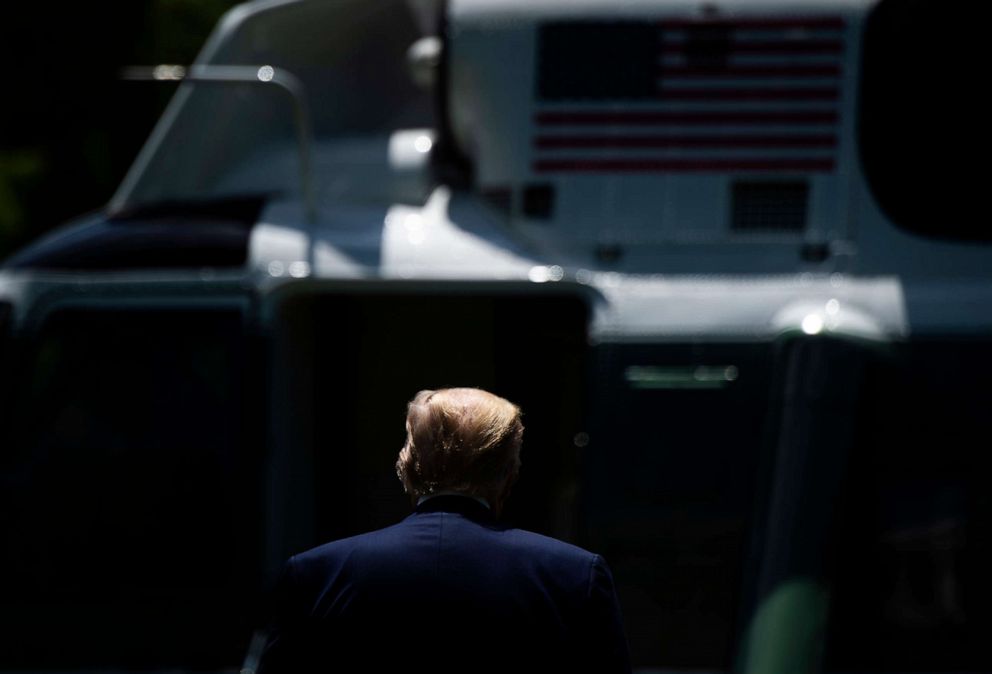
And following the president’s lead, the campaign had remained on the sidelines for days as Floyd's death sparked mass condemnation, including by presumptive Democratic nomniee Joe Biden, and devastated and took an emotional toll on the black community they are working to court. Many on the president's team began speaking out on Floyd's death on Thursday amid rising protests across the country and to condemn rioting.
"Looting is not protesting. Burning down local homes and businesses is not protesting. How sad that the memory of #GeorgeFloyd has been lost in all of this," Trump campaign senior advisor Lara Trump tweeted.
But as the campaign has worked to hijack the phrase “woke” in an attempt to connect with voters, selling hats, shirts, and hoodies embroidered with the phrase groups like Black Lives Matter worked to popularize, some believe their response in times of racial violence has been anything but socially aware of racial injustice.
"Like all Americans, the Trump campaign was shocked and horrified over George Floyd’s death. The campaign and our surrogates have been active in condemning both Floyd’s death and the violent outbursts that have followed it," Trump campaign communications director Tim Murtaugh said, pointing out that "unlike Joe Biden, who has no actual responsibilities, our candidate is the President of the United States, who has responsibility for the Department of Justice. When the President addressed Floyd’s death and quickly thereafter announced the DOJ civil rights investigation, the campaign amplified that action."
The campaign said they issued a statement to reporters on Floyd's death on Thursday and said "the country is still dealing with this tragedy, it is important for Americans to come together peacefully, call for clear-eyed justice, and unite as one nation.”
In contrast, it took moments for the re-election campaign to launch an all-out onslaught to attempt to smear former Vice President Joe Biden as a “racist” after his now infamous Breakfast Club interview, first posted online last Friday.
“This is disgusting,” the Trump campaign tweeted less than an hour after the interview appeared on YouTube, along with a clip of Biden telling radio host Charlamagne Tha God that black voters “ain’t black” if they’re still deciding between voting for him or the president. Biden later that same day during a call with the National Black Chamber of Commerce conceded that he was “much too cavalier” in his remarks, and said he did not take the black vote for granted.
Still in the hours leading up to that call, the president’s campaign team deployed a full-scale blitz utilizing its massive war chest, organizational might, and “Black Voices for Trump” coalition to try and capitalize on Biden’s comments as part of the Trump campaign’s latest effort to appeal to black voters, a core voting block for the former vice president and Democrats.
The Trump team helped push a #YouAintBlack hashtag that trended across Twitter--They dropped a $1 million ad-buy promoting Biden’s comments and labeling him a “racist." And before noon last Friday, the Trump campaign had scheduled and held a press conference call featuring South Carolina Sen. Tim Scott, the sole black Republican senator, to blast the presumptive Democratic nominee’s comments.
And as thousands took to the streets to demand justice for Floyd, the Trump campaign blasted its “Black Voices for Trump” email list on Wednesday afternoon still highlighting Biden’s comments, asking voters to mobilize behind President Trump.
On Friday night, the Trump campaign emailed supporters and the media a list of “what The Trump campaign is saying about the tragic loss of George Floyd,” which featured campaign officials like senior advisor Lara Trump condemning looting. But most Trump campaign officials remained silent regarding the incident until Friday when they issued statements online days later condemning the looting and protests in the wake of Floyd’s death along with condolences.
Biden first addressed Floyd’s death in a tweet on Tuesday calling for a “ thorough investigation” and adding “George Floyd deserved better and his family deserves justice. His life mattered.”
A day later, Biden again addressed Floyd’s death during a digital event on Wednesday, arguing that the incident--and its similarities to Eric Garner’s case from five years ago which saw a white New York City police officer caused the chokehold death a black man, proved just how much further the country needs to go to root out systemic injustice.
“It cuts at the very heart of our sacred belief that all Americans are equal in rights and in dignity, and it sends a very clear message to the black community and black lives that are under threat, every single day,” Biden said.
Along with touting the landmark criminal justice reform bill the president signed into law in late 2018, Trump had planned to use historically low black unemployment, which began to decline under President Barack Obama as his main pitching point to black voters, but with those numbers skyrocketing amid the coronavirus pandemic disproportionately impacting black and minority communities, his team has switched focus to painting Biden as a racist.
Plans for the Trump campaign to open up retail style community centers in several predominantly black cities in battleground states in an effort to pitch minority voters have been put off during the pandemic. Prior to the pandemic, Trump allies also held independent events in black communities, touting the president’s record and giving away thousands in cash.
In 2016, Trump won just 8% of African-American voters. And as the Trump campaign has ramped up efforts to court black voters, advisers say even a marginal increase in support in key battleground states would have a significant impact.
“It defies all logic and reason for Donald Trump to try to court black voters while trying to win white votes by calling black people 'thugs' and amplifying racial violence,” Yvette Simpson, CEO, Democracy for America and ABC News contributor said.
“The Trump campaign's attempts to win black votes aren't about serving black people, they're about distracting the public (and especially white voters) from the image of an incompetent president who used bigotry and racial resentment to fuel his political rise, and who continues to fuel the fire of hate and racism today,” Simpson told ABC News.
Darrell Scott, a close ally to President Trump told ABC News discussions are underway to resume those events.
Scott, who President Trump called a “very good friend” during a listening session with African American leaders in Michigan this month, serves as the CEO of the National Diversity Coalition for Trump and Urban Revitalization Coalition.
He pushed back against accusations the community events, which he called “nonpartisan” are trying to buy the black vote.
“To imply that the black community would have a vote to sell or to imply that we thought so less of the black community to entice them with the selling of a vote is offensive,” Scott told ABC News.
Scott, who also serves as a co-chair for the “Black Voices for Trump” coalition is one of few campaign officials who spoke out publicly immediately following Floyd’s death.
“It’s more than a “Black Rights” issue, it’s a “Human Rights” issue,” Scott stated on Twitter.
Related Topics

Popular Reads
ABC News Live