NASA is broadcasting a live feed of the Artemis II moon rocket from the Kennedy Space Center on Merritt Island, Florida.
Teams are activating the ground launch sequencer, the computer that will initiate terminal count -- the final, automated 10 minutes of launch countdown -- which will tell the rocket when to lift off.
Engineers are also initiating the air‑to‑gaseous nitrogen changeover inside the rocket's cavities. NASA says atmospheric air is replaced with inert nitrogen gas, which creates a stable environment before fueling operations.
What is the timeline of the Artemis II moon mission?
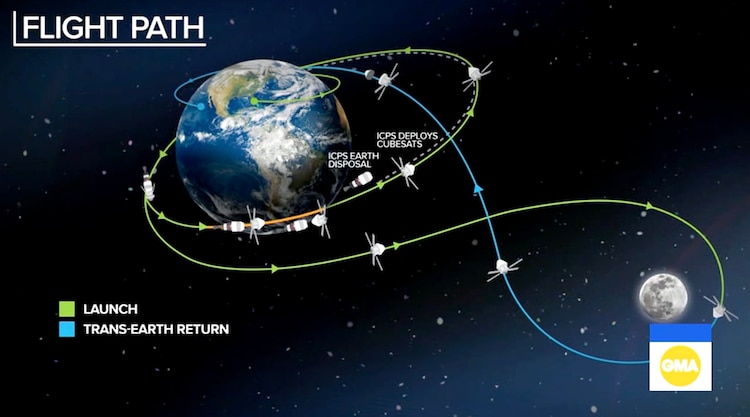
The Artemis II moon mission will see four astronauts go on a 685,000-mile, 10-day journey around the moon. Here is what the timeline looks like:
Day 1 is launch day. The astronauts lift off aboard NASA's newest spacecraft, Orion, which will sit atop the Space Launch System rocket. The spacecraft will reach initial orbit and then high-Earth orbit to make a push toward the moon.
Days 2 through 4 are transit days, with the journey to the moon taking three days. Over the course of the journey, the crew will continue to evaluate Orion's systems and practice emergency procedures, in addition to other activities.
Astronauts Reid Wiseman, Victor Glover, Christina Koch and Jeremy Hansen stop for a group photo during a visit to NASA's Artemis II SLS rocket and Orion spacecraft, March 30, 2026, at Launch Complex 39B of NASA's Kennedy Space Center in Fla.
Bill Ingalls/NASA/AFP via Getty Images
On day 5, Orion will enter the lunar sphere of influence, meaning the moon is the main gravitational pull. On day 6, the crew will come its closest to the moon while traveling the farthest from Earth, according NASA.
Days 7 through 10 will see the astronauts make their way back to Earth before re-entering Earth’s atmosphere at high speed, up to 25,000 miles per hour.
The Orion spacecraft will deploy a series of parachutes once through the heat of re-entry to slow down and it will splash down in the Pacific Ocean The U.S. Navy will recover the capsule.
-ABC News’ Mary Kekatos
Apr 01, 2026, 6:00 AM EDT
Who are the Artemis astronauts?
#Who are the Artemis astronauts?
Three Americans and one Canadian will be aboard the Orion spacecraft -- named "Integrity" -- over the course of 10 days.
The team consists of Victor Glover, Christina Hammock Koch and Reid Wiseman of NASA and Jeremy Hansen of the Canadian Space Agency.
NASA astronauts Reid Wiseman, Victor Glover, Christina Koch and CSA astronaut Jeremy Hansen stop for a group photograph as they visit NASA's Artemis II SLS rocket and Orion spacecraft, March 30, 2026 at the Kennedy Space Center in Florida.
Bill Ingalls/NASA
Wiseman is the commander of the Artemis II mission, Glover is the mission pilot, and Koch and Hansen are mission specialists.
Glover and Koch will also be the first person of color and first woman, respectively, to eventually step foot on the lunar surface in future Artemis missions.
-ABC News' Julia Jacobo
Apr 01, 2026, 5:59 AM EDT
What to know about NASA's Artemis II moon mission
Artemis II took astronauts around the moon for the first time in more than 50 years. The four-person crew launched from NASA's Kennedy Space Center on Merritt Island, Florida, on April 1 for a 10-day journey, with the splashdown set for Friday off the California coast.
The history-making trip will pave the way for future Artemis missions intended to eventually see astronauts set foot on the moon and the building of a permanent lunar base.
ABC News
Read more here about what you need to know regarding the Artemis II mission, including who the astronauts are and how to watch.